
We receive a message that looks like a Faljam notification, with a link to a well-designed page, a form asking for our banking details, and a promise of profit or reimbursement. Everything seems credible. This is precisely the problem: scams related to Faljam no longer resemble crude attempts filled with mistakes. They imitate known interfaces, exploit credible scenarios, and rely on urgency to short-circuit our vigilance.
Fake articles and deepfakes: the most difficult Faljam scam scenario to spot
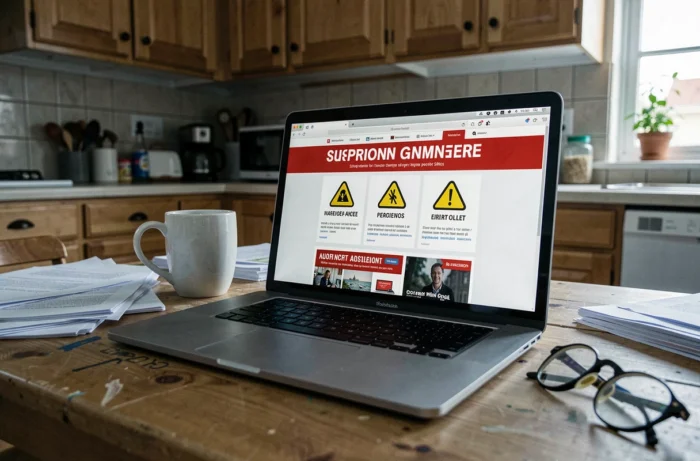
Since the end of 2025, there has been a surge in scams that rely on fake articles generated by artificial intelligence. The typical scenario: a link shared on social media or received via SMS leads to an article that appears journalistic. The text features a well-known personality claiming to reveal an investment method or an exclusive service.
The content is fluid, error-free, sometimes accompanied by a doctored video clip. Generative AI makes these fake contents almost indistinguishable from a real article. We are no longer talking about makeshift pages with pixelated logos.
To know how to recognize a Faljam scam, one must first accept that visual appearance is no longer enough as a filter. The reflex to adopt: check if the article actually exists on the cited media’s website. A Google search with the exact title in quotes is often enough to dispel doubt.

Check a Faljam link before clicking: the checks that really work
The URL remains the first reliable indicator. Fraudulent pages use domain names that resemble the original, with an extra letter, a hyphen added, or an unusual extension (.xyz, .top, .click instead of .fr or .com).
Before clicking on a link received via SMS, email, or messaging, one can apply a series of quick checks:
- Hover over the link (without clicking) to display the full URL in the browser’s status bar. If the displayed address does not match the official site, close it.
- Copy the URL and paste it into a verification tool like VirusTotal or Google’s Safe Browsing service, which flags pages listed as dangerous.
- Search for the domain name on the blacklists maintained by the ACPR and the AMF. These registers are regularly updated and cover fraudulent financial sites.
- Check for the presence of complete legal notices (SIRET number, physical address, reachable customer service). Their absence is a strong signal.
A legitimate site never asks for a credit card number to be entered via a link received by SMS. If the page displays a payment form after clicking on an unsolicited message, leave immediately.
Invoice, package, reimbursement: the Faljam scenarios that trap the most
The most effective scams do not play on the lure of profit. They exploit fear or administrative urgency. We receive a message mentioning an unpaid invoice, a package stuck in customs, or a pending reimbursement. The tone is neutral, professional. The link redirects to a page that mimics a known service.
The common point of these scenarios: an action requested within a very short timeframe. “Regularize within 24 hours,” “Confirm your details by tonight.” This time pressure aims to prevent any verification.
When faced with this type of message, the best practice is to never use the provided link. We connect directly to the official site of the concerned service (bank, operator, carrier) by typing the address into the browser. If an action is genuinely required, it will appear in the customer area.
The particular case of phone calls
Some variants combine SMS and voice calls. We first receive a message, then a call from a supposed advisor who “confirms” the process. This double contact reinforces perceived credibility, but no serious organization operates this way for sensitive transactions.
If an unknown number contacts you claiming to be related to Faljam, hang up and call the official number listed on the website or in your contractual documents.
Report a Faljam scam: concrete steps in 2026
Spotting an attempt is not enough. Reporting helps feed databases that protect other users. In France, several channels coexist and complement each other.
- The Pharos platform (accessible via internet-signalement.gouv.fr) allows for reporting any illegal online content, including phishing pages.
- Signal Conso, managed by the DGCCRF, covers abusive solicitation and misleading commercial practices, including by phone.
- The site cybermalveillance.gouv.fr offers guided diagnostics and directs users to the appropriate steps based on the nature of the scam.
In case of financial harm (debited amount, compromised banking data), contact your bank first to block the transaction, then file a complaint. The complaint can be filed online via the THESEE platform for internet scams.
From a civil perspective, the liability of the payment service provider may be engaged if the transaction was not authenticated by a strong security mechanism. Responses vary on this point depending on the institutions, but European regulations generally require reimbursement for unauthorized transactions.
The best protection remains a simple reflex: any unexpected message containing a link and requesting quick action should be treated as suspicious until proven otherwise. This is not paranoia; it is digital hygiene.