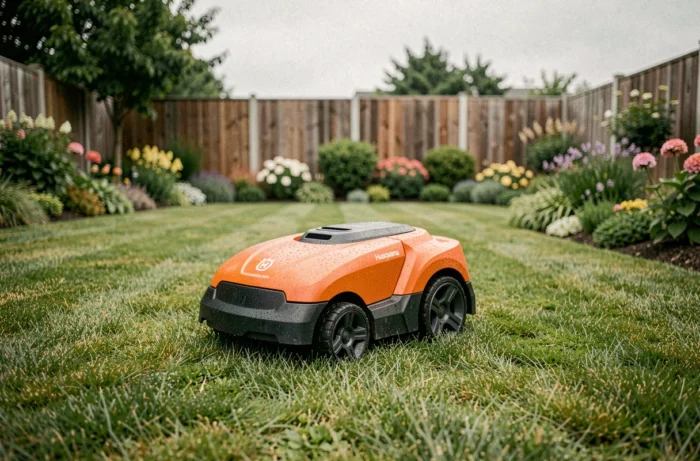
Mowing your lawn without lifting a finger is the promise of the Husqvarna Automower 310. This robotic mower targets small to medium-sized gardens with a traditional wired installation. However, there are discrepancies between the technical specifications and real-world performance. Here’s what to keep in mind before placing an order.
Automower 310, 310 Mark II or 310E NERA: three different robots
Before reading a review or comparing prices, a verification is necessary. Husqvarna markets several variations under the name “310,” and confusing them skews any comparison.
The original 310 operates with a buried or ground-fixed perimeter wire. The 310 Mark II retains this wired principle with software and ergonomic enhancements. The 310E NERA, on the other hand, switches to wireless technology, radically changing the installation and navigation.
When you consult a review of the Husqvarna Automower 310, always check which generation it is. Feedback on the 310E NERA does not describe the same device as the classic 310, nor the same budget.
Wired installation of the Automower 310: what no one shows in stores
The installation of the perimeter wire is the first real test, well before mowing. This wire defines the robot’s working area. It must be laid around the lawn, navigating around each flowerbed, tree, and border.
A guide wire complements the setup to help the robot find its charging station. On a simple rectangular terrain, the operation takes a few hours. On a garden with narrow passages, islands, or slopes, expect a full day or more.
A symptom attributed to the robot may stem from the installation itself. A poorly insulated cable connection, a mispositioned loop, or a cable damaged by a spade can cause navigation errors that are sometimes incorrectly attributed to the device. Testimonials on specialized forums confirm that diagnosis often involves a thorough check of the wired circuit before any intervention on the robot.
Mowing behavior on real terrain: slopes, noise, and results
The Automower 310 handles slopes of up to 40%. On dry terrain, this capability works as advertised. On wet grass on a slope, the wheels lose traction, and the robot may skid or reposition itself more frequently.
Regarding noise, this is one of the strong points often mentioned. The sound level remains very low compared to a gas mower. You can let it run in the evening without disturbing the neighbors.
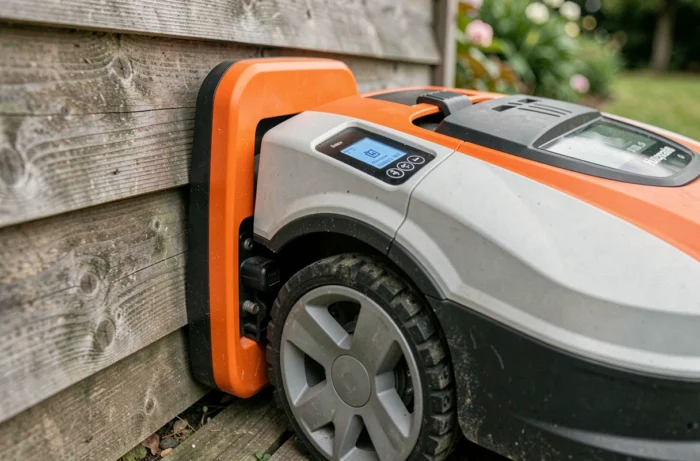
The cutting principle is random: the robot does not follow straight lines. It changes direction with each contact with the wire or an obstacle. This operation produces a uniform result after several passes, but the edges remain the main weak point. A strip of a few centimeters along walls, fences, and flowerbeds is never mowed. A manual trimmer remains necessary.
Everyday criteria that matter
- Battery life: the robot alternates between mowing cycles and returns to the station. On a surface close to its maximum capacity, it runs almost continuously throughout the day.
- Time programming: operating hours can be set to avoid times when the garden is occupied by children or pets.
- Collision and lift sensors: the robot stops if it is lifted or turned over, providing a minimum level of safety for a device accessible in a garden.
Spare parts and repair: a often overlooked criterion
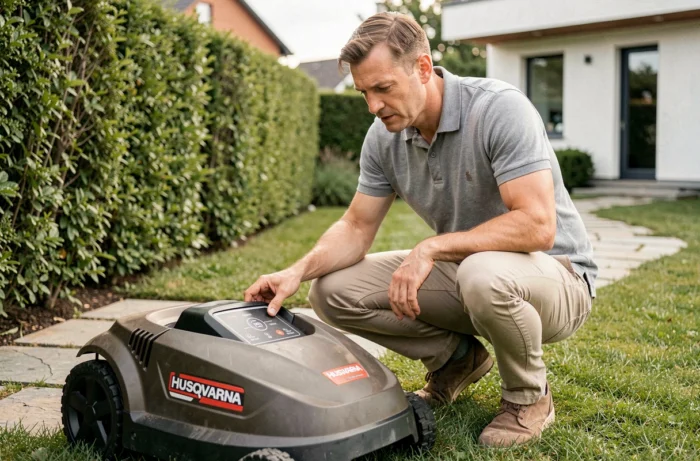
The blades wear out and need regular replacement. Husqvarna offers a network of authorized dealers and a structured after-sales service. The availability of spare parts (blades, wheels, battery, motherboard) varies according to dealers and the model generation.
Before purchasing, ask the question directly: does your local dealer provide maintenance and repairs? A robotic mower is not a disposable purchase. Over a lifespan of several seasons, the cost of blades, any battery replacement, and annual servicing adds to the initial price.
Regulation (EU) 2023/988, applicable since December 13, 2024, governs the general safety of consumer products in the European Union. It does not specifically target robotic mowers but strengthens manufacturers’ obligations regarding traceability and product follow-up after market release.
Automower 310: for what type of garden and user profile?
This robot is suitable for a modest-sized garden, relatively simple in its configuration. A rectangular or L-shaped terrain, with few obstacles, gets the best out of the device.
- Suitable terrain: open lawn, moderate slopes, few narrow passage areas.
- Less suitable terrain: fragmented garden into several plots, high proportion of flowerbeds and isolated trees, often wet sloping soil.
- User profile: someone willing to dedicate time to the initial setup and adjustment, then wants to forget about the mowing chore on a daily basis.
The mowing result improves over time, as the robot passes and repasses. The first weeks may seem disappointing if you compare it to a traditional mower that cuts in straight lines. The logic is different: the robot maintains a constant height through frequent passes rather than a sharp weekly cut.
The Automower 310 is neither a gadget nor a miracle solution. It is a reliable tool for those who accept its limitations, particularly regarding edges and wired installation. Check the exact generation of the model, anticipate maintenance costs over several years, and carefully test the wiring. The rest, the robot takes care of.