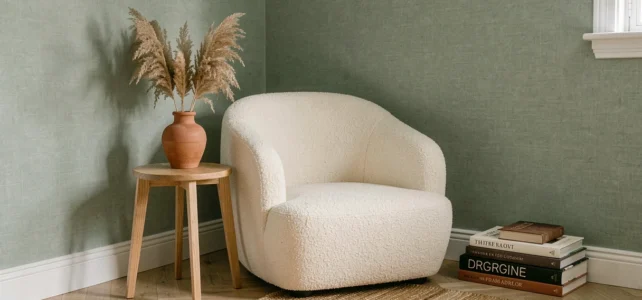
The trade shows of the first half of 2026, with Maison & Objet Paris leading the way, have outlined clear directions for interior decoration. Textured surfaces, generously proportioned furniture, new European requirements on formaldehyde emissions: the themes shaping the season go beyond mere color choices. They touch on materials, manufacturing processes, and how a piece of furniture or a covering interacts with indoor air.
Formaldehyde emissions and interior decoration: what is changing concretely
Since 2026, European regulations impose formaldehyde emission limits on furniture and many interior items sold in the European Union. The text does not only concern raw wood panels: it extends to finished products, including shelves, coffee tables, and certain storage elements.
For consumers, the direct consequence is more rigorous documentation from manufacturers and distributors. Voluntary certifications are becoming an increasingly expected benchmark in the supply chain.
Specifically, choosing a piece of furniture or wall covering in 2026 means checking its compliance with the new emission limits. Practices vary from one distributor to another: some already display emission test results, while others settle for a generic mention. Labeling remains heterogeneous depending on the brands and countries.
Browsing the home selection on Déco en Vogue allows you to spot pieces that integrate these new material requirements into their design, without sacrificing aesthetics.
Tactile materials and textured surfaces: the decor trend replacing color
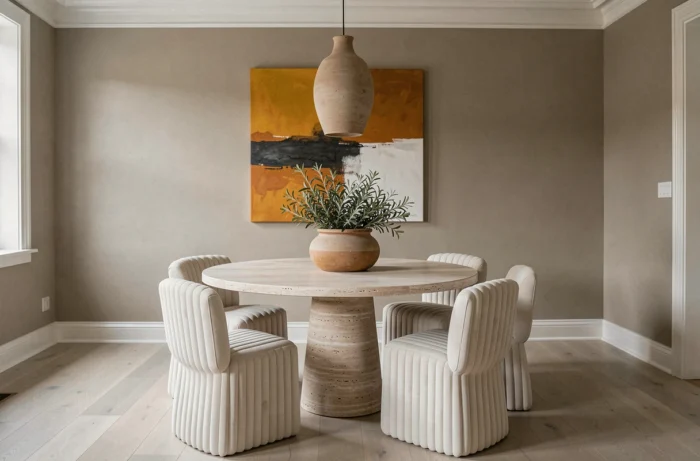
Color palettes remain a heavily covered topic in decor media. However, what truly distinguishes interiors this season is the primacy of texture over hue. Observations from Maison & Objet Paris 2026 confirm a strong emphasis on microcement, terracotta, and tactile textiles.
The idea is not to ban color, but to give it a perceptible physical support. A gray microcement wall does not have the same effect as a wall painted gray: light clings to it differently, and the hand perceives an irregularity. This sensory relationship to decor alters the ambiance of a room more than a simple change of shade.
Which materials to favor in a living room or bedroom
- Microcement, applicable on walls as well as countertops, provides an irregular mineral surface that ages without going out of style.
- Terracotta, in the form of tiles or decorative objects, introduces a warmth that industrial stones struggle to replicate.
- Textiles with visible weaves (thick linen, bouclé wool) on cushions, throws, or curtains add an immediate tactile dimension without heavy renovations.
- Dark woods, walnut or smoked oak, are gaining ground over the light species that dominated in recent years, with a visual depth enhanced by matte finishes.
The artisanal aspect of these materials serves as a common thread. Textured surfaces replace smooth finishes as a marker of a well-curated interior.
Rounded furniture and massive proportions: between sustainable trend and fashion effect
Rounded sofas, generously shaped armchairs, and tables with curved lines are not new to 2026. Reports from the latest trade shows confirm the persistence of this trend, with a notable evolution: proportions are becoming more massive and silhouettes more sculptural.
This furniture transforms the living room into a sort of gallery space, where each seat functions as an autonomous object. The visual result is appealing, but it raises a practical question rarely addressed: these bulky pieces require space. In a modestly sized apartment, a large sculptural sofa can overwhelm the room instead of enhancing it.
The available data does not allow for a conclusion on whether this trend toward massive furniture will last beyond two or three seasons. Previous cycles (end Scandinavian furniture, then mid-century, then curves) suggest that forms evolve through oscillation. Investing in a large rounded piece remains a bet on the durability of style.
Trending colors 2026: what warm shades say about the market
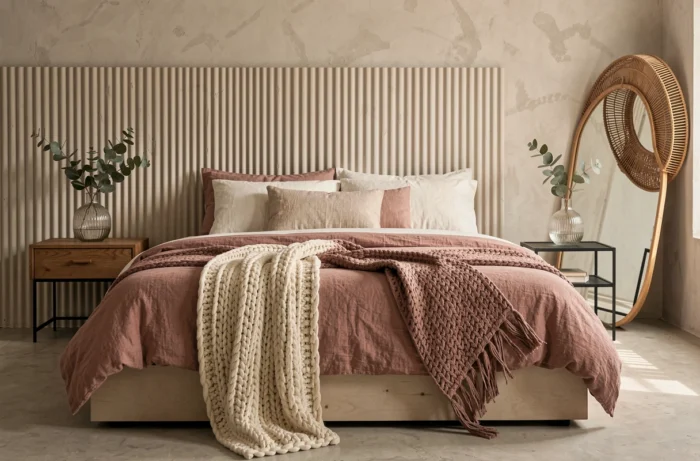
Deep clays, golden sands, and terracotta shades dominate the presentations of paint and coating editors this season. This convergence towards warm, earthy tones is not an isolated aesthetic coincidence: it accompanies the shift towards raw materials mentioned earlier.
Combining shades and textures without overloading the decor
The combination of terracotta on the floor, microcement wall, and dark wood furniture can veer towards a cave-like feel if the lighting does not compensate. An interior focused on natural materials works better with multiple light sources (table lamp, pendant, indirect lighting) than with a single central ceiling light.
Conversely, a living room with light walls that incorporates one or two textured elements, such as a raw linen cushion and a walnut table, gains depth without losing brightness. Frugality remains the best ally of an interior that lasts beyond a season.
The common thread of this decor season can be summed up in one word: material. Colors follow, furniture adapts, but it is the touch, the surface, the very chemical composition of objects that structures the choices. With the enforcement of European regulations on formaldehyde, the emission levels of a piece of furniture are now part of the selection criteria alongside its finish or design.