
Comparing modes of transport for a trip in France involves measuring differences in CO₂ emissions that vary in a ratio of one to over fifty depending on the chosen vehicle. The train, long-distance bus, bicycle, or carpooling do not offer the same service, but their climate performance allows for prioritizing options before booking anything.
This article confronts the available data to identify where the real gains in eco-friendly transport lie in France.
Navigation apps and the obligation to display the least polluting route
A French decree from 2022, fully implemented since then, requires digital travel assistance services to highlight the least emitting routes rather than the fastest ones. Waze, Google Maps, and their equivalents must now offer a slower-speed alternative whenever a route includes sections at 110 km/h or more.
This regulatory constraint changes car vacation planning even before departure. The traveler who enters their destination receives a clear signal about the carbon cost of their journey, which did not exist a few years ago. For those who wish to access the transport page of Le Voyageur Solidaire, this type of comparison between modes of transport is extended by resources dedicated to sustainable tourism.
The effect remains limited if the driver ignores the suggestion. However, coupled with the expansion of low-emission zones (LEZ) in major French urban areas, this system concretely encourages motorists to consider the train or bus for the long-distance portion of their trip.
Emissions by mode of transport in France: comparative table
Differences between modes of transport are often summarized vaguely. The table below synthesizes the orders of magnitude from ADEME data, in grams of CO₂ equivalent per passenger per kilometer, for a domestic French trip.
| Mode of transport | Indicative emissions (g CO₂eq/passenger-km) | Relevance for long-distance travel |
|---|---|---|
| TGV | Very low (among the lowest) | High |
| TER / Intercités | Low | Medium (connections) |
| Long-distance bus | Low to moderate | High |
| Carpooling (3 passengers) | Moderate | High |
| Individual car (thermal, 1 person) | High | High but very emitting |
| Domestic flight | Very high | High but the most emitting |
| Bicycle / electric bike | Almost none | Limited (short and medium distances) |
The TGV emits several dozen times less CO₂ than a domestic flight for a comparable trip. The long-distance bus falls within a low intermediate range, significantly below solo driving.
What this table does not show
The figures per passenger-km assume an average occupancy rate. Carpooling with four people becomes as efficient as a bus, while a car with a single occupant sometimes exceeds the emissions of a flight per passenger on certain short trips. The vehicle occupancy rate radically changes the carbon balance.
Tourist offices and integrated planning for sustainable mobility
Since 2024, several local authorities and ADEME have documented a changing role for tourist offices. These structures are no longer limited to promoting a destination. They now participate in local mobility committees and co-develop strategies to help vacationers leave their cars in the garage.
In practical terms, this translates into systematic information about train + bike combinations, local shuttles, and active mobility routes right from the homepage of tourist sites. An ADEME analysis published in 2026 emphasizes that reducing the carbon footprint of vacations involves this integrated planning at the local level.
- Proposing car-free routes as soon as accommodation is booked, with integrated train and shuttle schedules
- Providing bicycles (classic or electric) directly at the arrival station, in partnership with local rental companies
- Creating tourist routes designed to be accessible only by public transport or on foot
This model works best in areas already well-served by rail. In poorly covered rural areas, carpooling organized by tourist offices remains the main alternative to individual cars.
Bicycle and train-bicycle intermodality: the rapidly growing segment
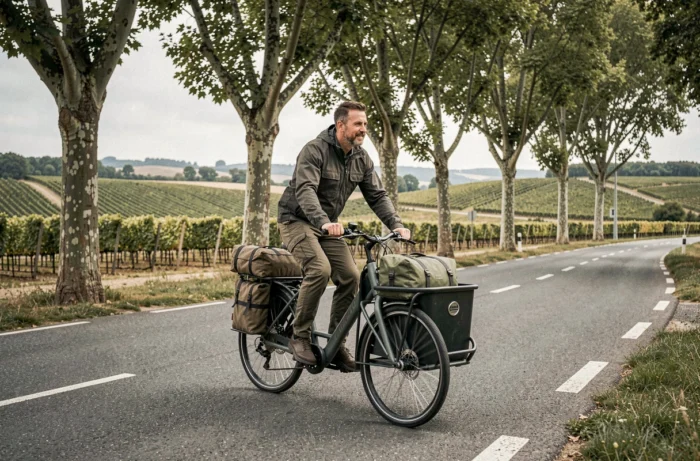
The bicycle generates almost no emissions, but its relevance for traveling in France depends on the ability to combine it with the train. Train-bicycle intermodality is the main lever to replace the car over distances of a few hundred kilometers.
SNCF has gradually expanded the acceptance of non-dismantled bicycles on TER and some Intercités, although space remains limited during the summer period. French bike routes (Loire à Vélo, ViaRhôna, Vélodyssée) then allow for exploring the destination without any motorized vehicle.
Practical limitations to be aware of
Reserving a bike space on a TGV remains challenging: the number of spots is capped, and summer slots fill up quickly. A folding bike circumvents this difficulty, but it requires an investment and a compromise on pedaling comfort. Anticipating the reservation of the bike space determines the feasibility of the trip.
For travelers who prefer electric bikes, the question of recharging along the way is less of an issue on marked routes, where charging points appear in accommodations labeled “Accueil Vélo.” On less frequented routes, it is better to plan for a battery with sufficient autonomy.
Labels and committed accommodations: a complement to transport choice
Choosing an eco-friendly mode of transport loses some of its effect if the accommodation upon arrival cancels out the gains. Several French labels (European Ecolabel, Green Key, Green Globe) certify measurable practices regarding water, energy consumption, and waste management.
A labeled accommodation is not necessarily more expensive than an equivalent non-certified one. The difference lies more in the location: committed establishments are concentrated in structured tourist areas, often better served by public transport, which reinforces the coherence of modal choice.
The environmental gain of a trip in France hinges on the combination of transport + accommodation + local mobility, not on a single link. Available data shows that the round trip accounts for the majority of the total carbon footprint of a stay, confirming that the choice of mode of transport remains the most decisive decision.