
Noni (Morinda citrifolia), also known as nono in Tahitian, presents a formulation challenge that most preparation guides overlook: its aromatic profile, dominated by short-chain fatty acids (butyric acid, hexanoic acid), makes pure juice difficult for most palates to accept. Preparing fresh noni juice that will actually be consumed over time requires mastering both the ripeness of the fruit, the extraction method, and the dilution strategy.
Fruit Ripeness and Extraction: The Technical Point That Recipes Simplify
A noni picked too early (firm flesh, green skin) yields juice low in beneficial compounds and excessively astringent. The appropriate stage is when the skin becomes translucent, almost whitish, and the fruit yields to slight pressure. At this stage, the characteristic smell of noni intensifies significantly, indicating that natural enzymatic fermentation has begun in the pulp.
Two extraction methods coexist, and the choice is not trivial.
The first, known as traditional, involves placing whole ripe fruits in a glass container, covered with a cloth, and allowing them to ferment in the sun for several weeks. The juice flows out by gravity. This method produces a fermented liquid, more concentrated in secondary metabolites, but with a particularly pronounced taste.
The second, quicker method uses a blender: the pulp of the ripe fruit is cut, blended with a bit of filtered water, and then strained through a cheesecloth or fine sieve. We recommend this approach for anyone starting out, as it allows for control over texture and immediate dosing. You can learn more about noni juice and its preparation variations to adapt the method to your constraints.
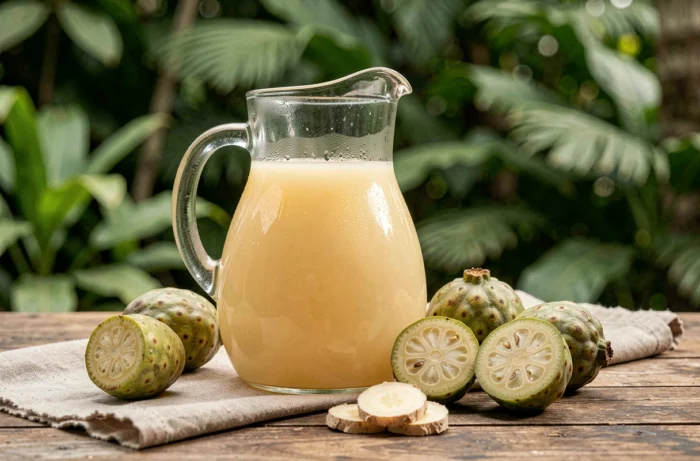
Fresh Noni Juice in Micro-Doses: The Strategy That Changes Adherence
The majority of treatment dropouts stem from taste, not lack of motivation. Recent consumer-targeted content confirms an underlying trend: incorporating noni in small amounts into a smoothie or composite juice yields much better adherence results than a pure shot on an empty stomach.
The common dose is around one to two tablespoons of fresh juice per day. Rather than swallowing it pure, we find it blends easily into a mixture with banana, pineapple, mango, or coconut water. The natural sugar from these fruits effectively masks the bitterness and cheesy notes of noni.
Concrete Mixing Protocol
- Pour one to two tablespoons of filtered fresh noni juice into a blender.
- Add a sweet fruit (ripe banana, mango, pineapple) and a base liquid (coconut water, apple juice, still water).
- Blend briefly to homogenize without heating the mixture, preserving the heat-sensitive compounds in the pulp.
This “integrated micro-dose” format on a daily basis advantageously replaces intensive high-dose treatments lasting several weeks, which are often abandoned after a few days. The goal is a regular long-term consumption, not a heroic protocol.
Documented Benefits of Noni Juice and Limits to Know
Noni contains phenolic compounds and iridoids attributed with a well-documented antioxidant activity for this fruit. This is the benefit on which scientific literature is most convergent. Effects on immune defenses or vitality are more related to individual perception than solid evidence.
In terms of nutrition, noni juice provides potassium, vitamin C, and various micronutrients, but the amounts ingested with one or two tablespoons remain modest. Noni is not a substitute for a balanced diet; it integrates as a sporadic supplement.
Profiles That Should Avoid Noni
Recent medical syntheses emphasize several contraindications often absent from mainstream articles:
- History of liver or kidney damage: noni contains potentially hepatotoxic compounds in high doses or with prolonged use.
- Hyperkalemia or treatments increasing blood potassium: the potassium content of the fruit may worsen the imbalance.
- Use of nephrotoxic or hepatotoxic medications: the risk of additive interaction warrants prior medical advice.
Even homemade fresh juice, perceived as “natural,” is not trivial for these profiles. We systematically recommend consulting before starting regular consumption in these cases.

Storage of Fresh Noni Juice: Duration and Common Mistakes
Juice extracted with a blender, unfermented, can be stored in the refrigerator in an airtight glass container. Beyond a few days, the microbial load increases rapidly without pasteurization. Preparing small quantities at a time remains the best approach.
Traditionally fermented juice, due to its more acidic pH, lasts longer, but its taste profile evolves continuously. The color darkens, and the smell intensifies. Juice that shows mold on the surface or has a noticeably different odor from the usual acidity should be discarded without hesitation.
Freezing works well for fresh unfermented juice. Pouring the juice into ice cube trays allows for calibrated portions to be added directly to a smoothie, without prior thawing. This format also facilitates adherence to the daily micro-dose without additional handling.
Noni remains a unique fruit whose preparation into fresh juice requires more method than equipment. Mastering the ripeness stage, opting for dilution in a smoothie, and respecting storage limits is sufficient to obtain a consumable product over the long term, without abandoning the treatment after three days in the face of a glass with an off-putting taste.