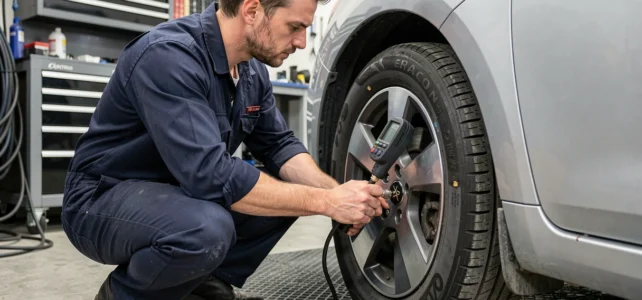
On a Citroën C2 loaded with three passengers and a full trunk for a vacation departure, a slightly under-inflated tire by a few tenths of a bar radically changes the vehicle’s behavior. The braking distance increases, fuel consumption rises, and tire wear accelerates asymmetrically. Knowing the exact pressure suited to its engine and load is essential for driving safely with this small city car.
Manufacturer’s label on the Citroën C2: the only reliable reference
There are dozens of pressure tables online for the C2, but the values vary from one site to another. The only authoritative source remains the label affixed to the driver’s door pillar or in the fuel flap. It is Citroën that has calibrated these values based on the unladen weight, weight distribution, and approved tire dimensions for each engine type.
The sidewall of the tire also displays a pressure, but this corresponds to the maximum load that the tire can support. It is not a recommended inflation pressure. An article detailing the tire pressures for Citroën C2 by engine type allows for cross-referencing this data with that in the maintenance booklet.
In case of doubt (label faded, door replaced after an accident), the original user manual contains the same information. It can also be found at a Citroën dealer.
Tire pressures for Citroën C2 by engine type: reference values
Not all C2s are inflated the same way. The engine, tire size, and load level determine the target pressure. Here are the values from the manufacturer’s recommendations.
| Engine Type | Tire Size | Front (normal) | Rear (normal) | Front (loaded) | Rear (loaded) |
|---|---|---|---|---|---|
| 1.1 i | 175/65 R14 82T | 2.2 bar | 2.2 bar | 2.2 bar | 2.2 bar |
| 1.4 HDi | 175/65 R14 82T | 2.5 bar | 2.5 bar | 2.5 bar | 2.5 bar |
| 1.4 i | 175/65 R14 82T | 2.3 bar | 2.3 bar | 2.3 bar | 2.3 bar |
| 1.4 i | 185/55 R15 82H | 2.3 bar | 2.3 bar | 2.3 bar | 2.3 bar |
| 1.6 i 16V | 195/45 R16 80V | 2.4 bar | 2.4 bar | 2.4 bar | 2.4 bar |
It is noted that the 1.4 HDi requires the highest pressure (2.5 bar), which is explained by the greater weight of the diesel engine. The sporty version 1.6 i 16V, fitted with 195/45 R16 tires, is set at 2.4 bar.
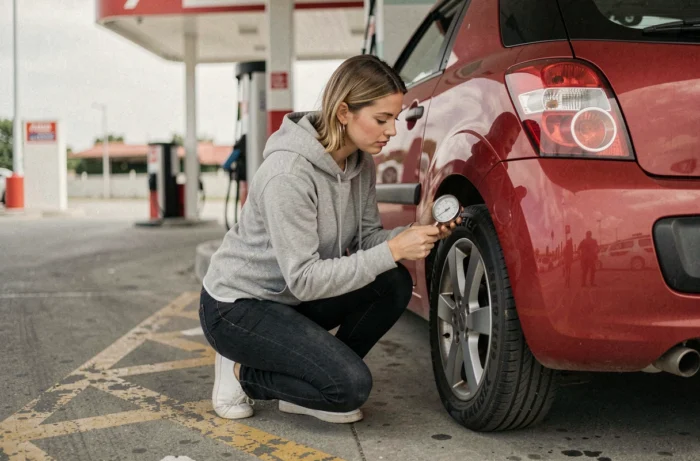
Notably, on the C2, the front and rear pressures are identical, even when loaded. This is a feature related to the short wheelbase and weight distribution of this city car. On other Citroën models, the difference between axles can reach 0.3 bar.
Cold tire pressure check: frequency and method
Checking the pressure once a year during the technical inspection is not enough. A tire naturally loses pressure over the weeks, even without a puncture or visible leak. Maintenance professionals recommend checking at least once a month, with cold tires.
“Cold tires” means that the vehicle has not been driven for at least two hours, or less than three kilometers at low speed. After a trip, the heat generated by friction increases the internal pressure, which skews the measurement.
In practice, one can adopt this routine:
- Check the pressure in the morning before starting, using a personal gauge or at the nearest gas station
- Systematically check before a journey of more than two hours or an unusual load (luggage, roof rack)
- Visually inspect the sidewalls of the tires to spot any abnormal sagging, a sign of significant under-inflation
- Never deflate a warm tire that shows a pressure above the recommended level: this is normal, the pressure will drop when cold
A digital gauge costing a few euros provides more accurate measurements than gas station pumps, which are often poorly calibrated. The investment is minimal for a Citroën C2 lacking standard TPMS sensors.
Under-inflation and over-inflation on Citroën C2: concrete effects on the road
A difference of 0.3 bar from the recommended pressure may seem trivial. In practice, on a car as light as the C2, the consequences are quickly felt.
Under-inflated tires: wear and consumption
When the pressure is too low, the contact surface on the ground increases on the edges of the tire. Wear concentrates on the shoulders, which reduces the tire’s lifespan. Rolling resistance also increases, and fuel consumption is affected, especially in the city where the C2 spends most of its time.
Road behavior also deteriorates: heavier steering, decreased responsiveness in corners, and an increased risk of tire overheating on the highway.
Over-inflated tires: comfort and grip
Conversely, an over-inflated tire only touches the ground at the center of the tread. Grip decreases on wet surfaces, the suspension absorbs fewer road irregularities, and comfort significantly deteriorates on cobblestones or speed bumps.
On the C2, whose rear axle is a deformable beam (semi-rigid axle), over-inflation at the rear amplifies the bouncing and makes the car unstable at high speeds.
Tire pressure and technical inspection: what is checked
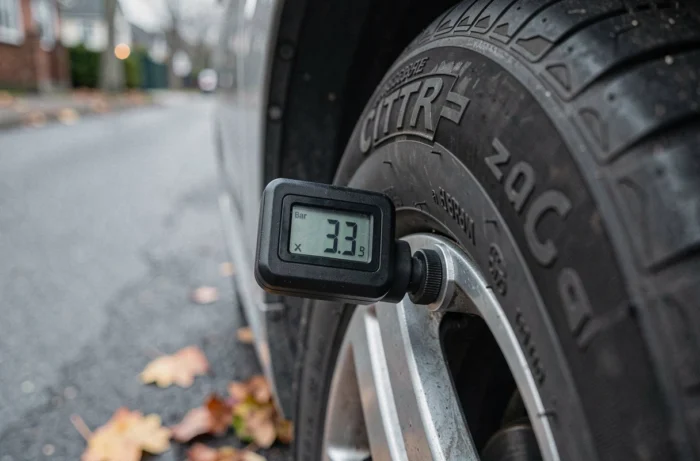
During the technical inspection, the condition of the tires is one of the points inspected. Irregular wear related to improper inflation can lead to a remark, or even a defect if the tread depth falls below the legal threshold of 1.6 mm on any part of the tread.
Correct inflation throughout the year protects against premature wear that could pose a problem on the day of the inspection. On an older C2, whose tires are not always replaced at the scheduled intervals, this is a point to monitor closely.
The pressure itself is not measured during the technical inspection, but its consequences (abnormal wear, sidewall deformation) are. Maintaining 2.2 to 2.5 bar according to the engine type remains the simplest way to avoid unpleasant surprises.