What decor trends are truly marking the start of the 2026 season, and which are merely marketing recycling? Between the signals observed at the Maison & Objet fair, the return of materials thought to be forgotten, and the emergence of concepts like burrowcore, the directions taken by interior decoration this year deserve to be compared for clarity.
Burrowcore and second-hand: two sustainable decor approaches face to face
Two movements structure home decoration in 2026, but they do not respond to the same logics. Burrowcore, documented by Le Journal de la Maison in September 2026, focuses on vintage furniture and cozy materials to create a cocoon-like interior. Second-hand decor, on the other hand, relies on thrift shopping and resource centers to compose unique spaces.
| Criterion | Burrowcore | Second-hand decor / reuse |
|---|---|---|
| Principle | Create a cocoon with vintage furniture and enveloping textures | Thrift, repair, keep objects with strong patina |
| Dominant materials | Wool, corduroy, patinated wood | Any material depending on the find (ceramics, metal, wood) |
| Source of supply | Specialized brands, capsule collections | Thrift stores, resource centers, resale platforms |
| Relationship to time | Assumed nostalgia, inspiration from the 70s-80s | Sustainability as an aesthetic criterion (patina, history) |
| Typical budget | Variable depending on collectible pieces | Generally lower, but depends on rarity |
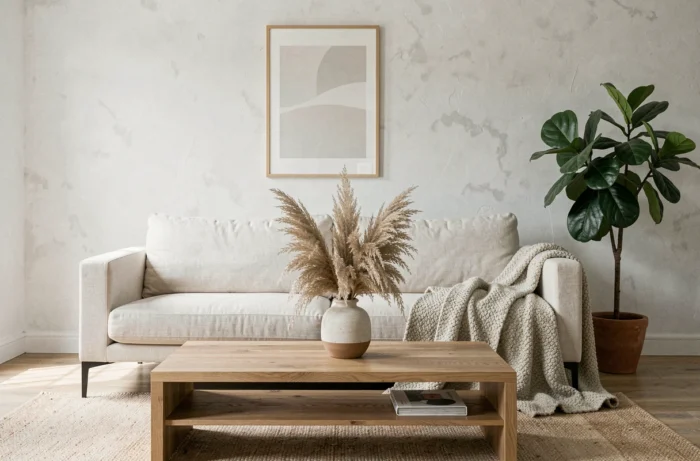
Burrowcore offers a precise, almost scripted aesthetic. Second-hand transforms sustainability into a visual bias, where the patina and uniqueness of an object matter as much as its function. These two approaches can coexist in the same interior, but their purchasing philosophy diverges sharply.
Trade shows like the one presented on salondelamaison.fr allow for a confrontation of these trends with the actual collections of manufacturers and designers, helping to distinguish underlying movements from fleeting fads.
Earth tones and dark wood: the 2026 decor palette analyzed
Competitors all talk about colors, but rarely the same ones. SeLoger highlights theatrical red and celadon. Hemea cites emerald green and curry yellow. MaisonInsider documents a shift towards earth tones and matte dark wood.
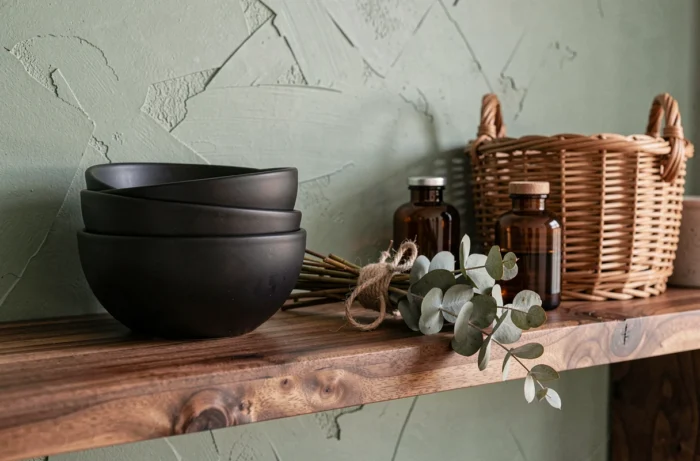
This last signal is the most coherent with other trends of the season. Burrowcore calls for warm, muted shades. Second-hand decor values natural finishes. Bright colors (red, straw yellow) function as occasional accents, not as the chromatic base of an entire interior.
What Maison & Objet 2026 confirms about shades
The September 2026 edition of the fair showcased spaces where walls and furniture share the same muted color range. Strong contrasts recede in favor of earthy tones, from brown to sand to khaki. Dark wood, long eclipsed by light Scandinavian oak, returns on consoles, tables, and shelves.
In contrast, pure white and soft pastels, still very present in Scandinavian-inspired interiors, are losing ground in the new collections presented to professionals.
Pet Square and mental well-being: two unexpected decor trends
Beyond colors and materials, two signals captured at Maison & Objet 2026 deserve attention because they shift the subject of decoration towards concrete uses.
- Pet Square: a device dedicated to the pet as a member of the household. Furniture now integrates spaces designed for cats or dogs (nooks built into furniture, cushions coordinated with the living room). It is no longer an accessory; it is a design criterion.
- Decoration and mental health: several setups at the fair connected interior design and psychological well-being. Lighting, fabric texture, and furniture arrangement are presented as levers for emotional comfort, not just aesthetics.
- Reimagined craftsmanship and handmade: decorative objects made by hand or in small series are gaining visibility, driven by a demand for uniqueness that industrial collections no longer satisfy.
These three directions share a common point: the home is no longer decorated to be shown, but to be lived in. The focus shifts from the visual to the sensory and functional.
Natural materials and organic shapes: beyond marketing discourse
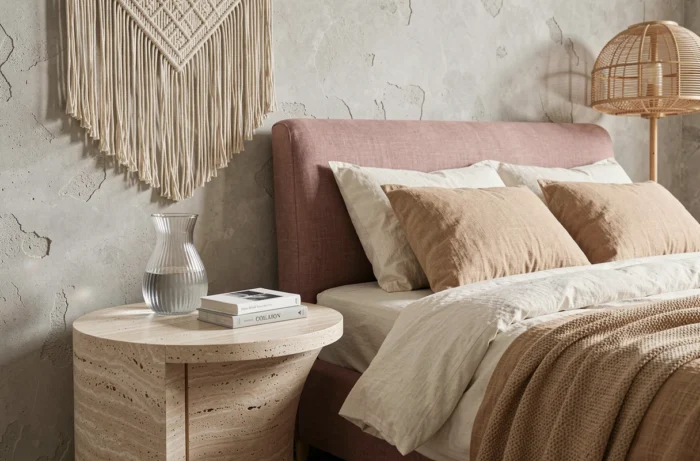
Every year for the past five years, natural materials have been announced as a trend. In 2026, the difference lies in their treatment. Wood is no longer simply “light and Scandinavian”: it is dark, matte, sometimes left raw with its irregularities. Textured finishes replace smooth and uniform surfaces.
Organic shapes (asymmetrical curves, irregular roundness) dominate the furniture presented at the fair. Mirrors, consoles, and seating abandon right angles. This evolution has a practical consequence: furniture with organic shapes requires more space around it to exist visually, prompting decluttering.
Light wood versus dark wood: a measurable shift
In contrast to the light oak that has dominated collections for several years, dark woods and walnut or wenge shades are returning to the catalogs of exhibiting brands. This shift is also observed in bedding and upholstery colors, where chocolate and tobacco tones are gradually replacing ecru linen.
The 2026 decor trend is not just a list of colors or styles. It reflects a change in the relationship to domestic objects: less accumulation, more coherence between material, use, and lifespan. Interiors that age well are those where each piece of furniture has been chosen to last, not to follow a season.