
The Makita DHS680Z is an 18 V LXT cordless circular saw with a brushless motor, sold as a bare tool. It has accumulated over 7,000 user ratings with an average score of 4.7/5, making it one of the most proven references in the segment. We put it to the test over several weeks on-site to detail what the product sheets do not show.
Brushless Motor of the DHS680Z: Performance Under Real Load
The brushless unit of the DHS680Z maintains a stable torque even when the blade encounters a knot or a hard wood area. We observe a significantly less pronounced drop in RPM compared to the carbon models in the same Makita range. The motor does not stall in thick softwood, provided the blade’s natural feed rate is respected.
The electronic management cuts off power in the event of a complete blockage. This anti-kickback device reacts in a fraction of a second. On a job site where cuts follow quickly, this responsiveness prevents violent jolts that tire the wrists and damage the workpiece.
The brushless technology also provides a direct gain in battery life. Without the friction of carbon brushes, the amperage consumption remains contained. With a 5 Ah LXT battery, we made several dozen cross cuts in 18 mm plywood before dropping below the two LED charge indicators.
In comparison, a conventional motor would have required a battery change sooner. Our review of the Makita DHS680Z offers a detailed comparison of battery life based on the batteries used.
Cutting Depth and Precision at 90° and 45°
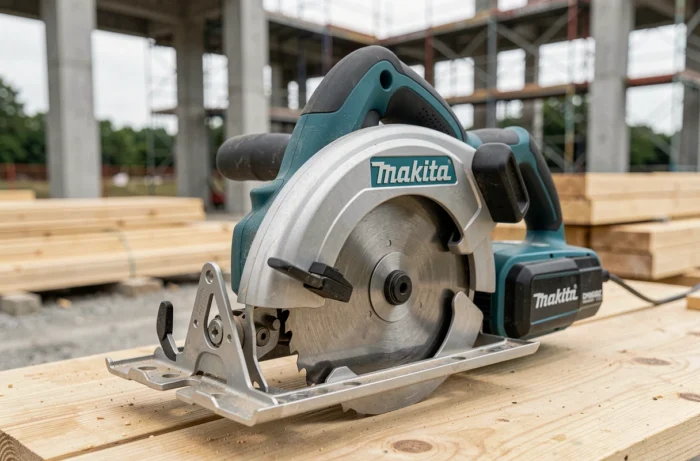
The DHS680Z features a cutting depth of 57 mm at 90°. This is sufficient to cut through a standard rafter or an MDF panel in a single pass, but too limited for thick beams. At 45°, the capacity decreases significantly, sometimes requiring the workpiece to be flipped for angled cuts in thick solid wood.
The aluminum base remains flat after months of use. We noted no play in the angle adjustment, even after numerous adjustments to the stop. The bevel lock holds its position without slipping under vibrations.
165 mm Blade: A Size That Requires Compromises
The 165 mm diameter limits depth but reduces the overall weight. This size prioritizes maneuverability at the expense of raw capacity. For panel cuts in the workshop, this compromise is relevant. For framing wood, one should consider a model with a 190 mm blade or larger.
The quality of the cut directly depends on the blade mounted. The original blade supplied is suitable for quick cuts in softwood. For melamine or fine veneer plywood, we recommend a blade with alternate teeth and a higher tooth count.
LXT Battery Compatibility and Positioning in the Makita Ecosystem
The DHS680Z operates exclusively on the Makita LXT 18 V platform. It does not accept 40 V XGT batteries without an adapter. This point deserves attention for users gradually migrating to the 40 V range: the DHS680Z remains anchored in the 18 V ecosystem.
The advantage of the LXT range is its extensive catalog. Drills, impact drivers, grinders, job site vacuums: all share the same battery format. Acquiring the DHS680Z as a bare tool makes perfect sense when you already own several LXT batteries.
- LXT 3 Ah batteries are sufficient for occasional cuts on light jobs, but limit runtime on extended sessions.
- LXT 5 Ah batteries offer the best autonomy-to-weight ratio for this saw, without excessively weighing down the machine.
- LXT 6 Ah batteries add runtime but shift the center of gravity backward, which alters handling on vertical cuts.
Ergonomics and Parallel Guide: Field Details

The DHS680Z is light enough to be used one-handed for short cuts, although we do not recommend this practice for safety reasons. The rubberized handle absorbs vibrations well during long sessions. The depth unlock button falls naturally under the thumb.
The parallel guide supplied with the bare tool serves its purpose for repetitive straight cuts on narrow panels. For precise cuts on large panels, a dedicated guide rail becomes necessary. The rail is not included, which remains the main complaint from users.
Dust Extraction Port and Dust Management
The integrated dust extraction port connects directly to a job site vacuum. The chip ejection from the casing is directed to the rear, clearing the cutting line. In practice, without a vacuum connected, dust quickly disperses in the workshop. On outdoor job sites, this point is secondary.
Concrete Limitations of the Makita DHS680Z
The bare tool version (the “Z” in the reference) does not include a battery, charger, or case. For a first-time buyer in the Makita ecosystem, the total cost of equipment (saw + battery + charger) significantly exceeds the displayed price of the tool alone.
- No speed control: the blade runs at a single speed, limiting adaptation to soft or fragile materials.
- No guide rail provided: long cuts on panels require an additional investment.
- Cutting depth of 57 mm at 90°: insufficient for wood sections over 50 mm.
- No native compatibility with Makita’s 40 V XGT batteries.
The DHS680Z remains a circular saw designed for mobility and panel cutting, not for processing solid wood. Users looking for a versatile machine for the workshop and light job sites will find a reliable and precise tool. Those who regularly work with thick wood will need to supplement their equipment with a model that has a greater cutting capacity.