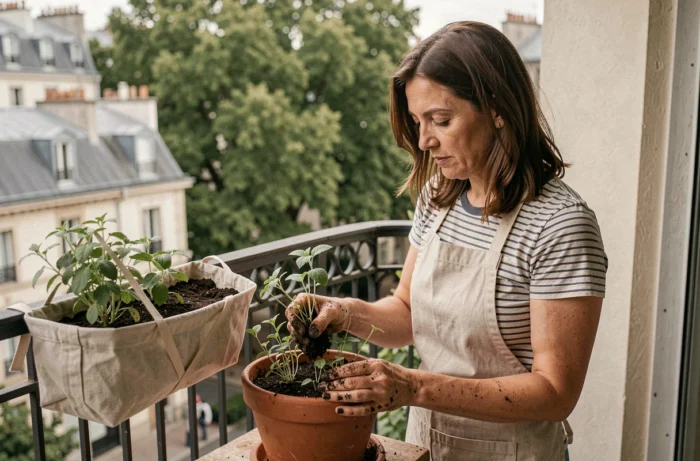
Urban organic gardening relies on an often underestimated starting constraint: the balcony or terrace is not natural soil. It is a concrete slab, with a limited load capacity, a microclimate amplified by the walls, and a regulatory framework related to the co-ownership. Growing vegetables and herbs under these conditions requires precise technical choices, much more than simply placing containers randomly.
Balcony load capacity: the calculation that no one makes before planting
Before buying any pots, the first data to check is the maximum load that your balcony or terrace can support. A container filled with wet substrate, along with its drainage tray and the growing plant, weighs much heavier than the dry potting soil sold in garden centers.
Several medium-sized containers spread across the surface are preferable to a single large central container. The heaviest containers should be placed near load-bearing walls, where the structure is most resistant. For a cantilevered balcony (without ground support), caution requires checking the allowable capacity with the property manager or a building professional.
In addition to these urban organic gardening tips, keep in mind that the load is always calculated under maximum watering conditions, not when dry. This reflex avoids structural surprises during the first heavy rain.
Co-ownership regulations and balcony garden: what is regulated
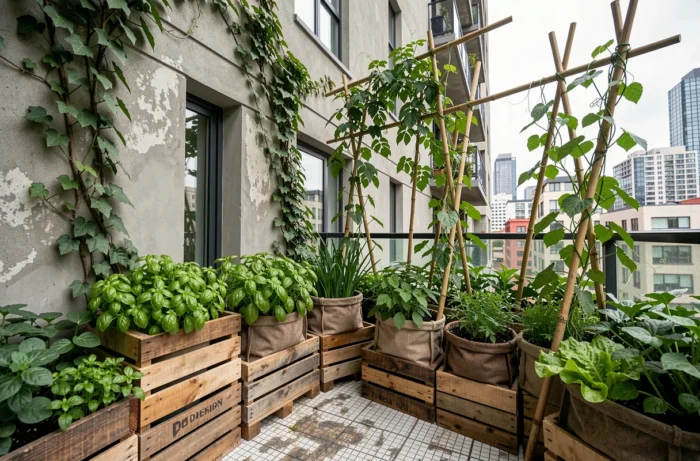
A container simply placed on the ground generally falls under the normal use of the balcony. However, as soon as there is drilling (wall mounting for a vertical system, support for a hanging planter on the street side), the co-ownership’s agreement may be required.
The co-ownership regulations potentially govern the color of containers visible from the outside, their height relative to the guardrail, and the overflow of vegetation. The drainage of watering water to lower balconies is another sensitive point: a saucer or draining mat is not optional; it is part of good neighborliness as well as the obligation not to cause nuisance.
Rainwater harvesting on a balcony
Installing a small rainwater collector seems logical when growing organically. However, this water is not suitable for human consumption and must never be connected to the drinking water network. If the installation is connected to the internal network of the dwelling, additional requirements apply (identification of withdrawal points, physical separation of networks, declaration as applicable).
A tank, even of small volume, also creates a concentrated load on the slab. This question relates to the total authorized weight, addressed above.
Substrate and drainage for growing organic vegetables in pots
In the ground, living soil naturally regulates water, air, and nutrients. In pots, everything depends on the chosen substrate and the quality of drainage. Organic potting soil alone compacts in a few weeks, retains too much water, and suffocates the roots.
An effective mix for a balcony garden combines several components:
- Organic potting soil as a base, providing organic matter and moderate water retention capacity
- Perlite or pumice to lighten the substrate, improve drainage, and limit the total weight of the container
- Mature compost (homemade or purchased) to nourish the plants over time without resorting to synthetic fertilizers
- A layer of clay balls at the bottom of the pot, separated from the substrate by a geotextile felt, to prevent drainage holes from clogging
This mix allows for keeping an aerated substrate even after several months of cultivation. It is partially renewed each season by adding fresh compost and removing dead roots.
Exposure and microclimate: adapting crops to your orientation
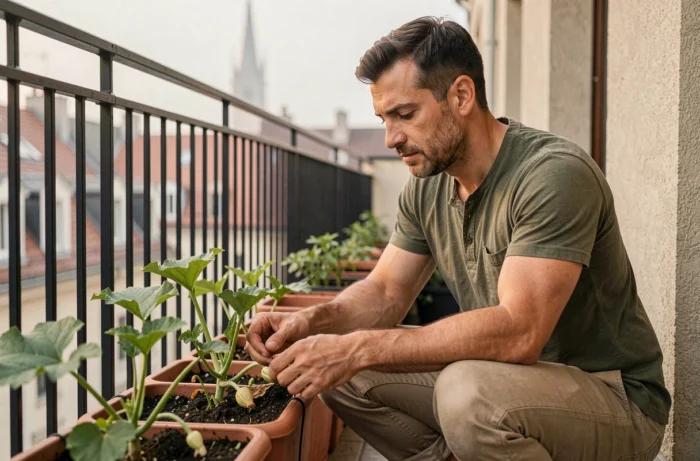
On a balcony, the sun and wind are amplified by the surrounding walls. A south or southwest orientation offers the best sunlight for fruiting vegetables (tomatoes, peppers, zucchinis), which require at least six hours of direct sunlight. Salads, spinach, and leafy herbs are satisfied with four hours and tolerate an east or northwest exposure better.
The wind dries out pots much faster than in the ground. A balcony on a high floor experiences currents that increase evapotranspiration. Grouping pots, installing a permeable windbreak, or placing the most delicate plants behind the hardiest reduces this water stress.
Organic pot watering: frequency and method
The most common mistake is to water little but often, which keeps the surface moist without reaching the deep roots. Less frequent but generous watering, until water flows out of the bottom of the pot, promotes deep rooting and more resilient plants.
To limit evaporation, an organic mulch (straw, buckwheat husks, shredded dead leaves) on the surface of the pot makes a noticeable difference. It also protects the substrate from sudden temperature variations, which are frequent on a south-facing balcony in summer.
Choosing vegetables and herbs suitable for an organic balcony garden
Not all vegetables are suitable for pot cultivation. Species with strong root development (potatoes, long carrots) require very deep and heavy containers. Conversely, some plants thrive in a small space:
- Cherry tomatoes, compact and productive, provided they are staked and receive sufficient sunlight
- Radishes, with a short cycle, harvested in a few weeks and ideal for occupying a pot between two crops
- Basil, chives, and parsley, which grow well in pots and are used daily in cooking
- Ever-bearing strawberries, which produce over several months in a planter or hanging pot
Favoring dwarf or compact varieties (dwarf tomato, bush zucchini) reduces the volume of substrate needed and thus the total weight. Organic seeds, available from specialized seed suppliers, ensure untreated and reproducible seeds.
The organic balcony garden does not aim to replicate a full soil garden. It is a system constrained by weight, wind, exposure, and building regulations. Each choice of container, substrate, or variety stems from these physical constraints. By integrating them from the start, even modest harvests become reliable and consistent.