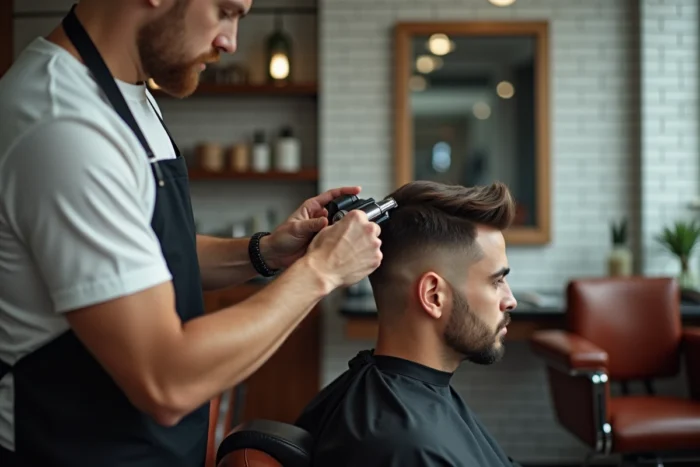
The blended V fade combines two contradictory requirements: a sharp geometric line at the back of the head and a gradual transition to the longer lengths. Successfully achieving this cut requires mastering the order of actions, the choice of tools, and the timing between wet and dry hair. What technical mistakes create the most discrepancies between the expected result and the final outcome of a blended V fade for men?
Fade on wet or dry hair: the result gap depending on the method
| Step | Wet Hair | Dry Hair | Risk if only one method is used |
|---|---|---|---|
| Tracing the V and rough cutting | Recommended: the bulk is easier to control, the clippers glide without snagging | Not recommended: the strands flip and distort the line | Asymmetrical V if traced only on dry hair |
| Blending the intermediate layers | Acceptable for a first pass | Recommended: the demarcations appear as they are in daily life | Invisible steps on wet hair, visible after drying |
| Finishing the nape and contours | Not recommended: wet skin reacts differently to the blade | Recommended: the razor or zero clippers give a clean line | Blurred contours, irregular regrowth from the first week |
Recent technical tutorials confirm this two-step approach: establish the structure on wet hair, then finalize the fade on dry hair. Working the fade entirely on wet hair produces a mass that appears homogeneous, but once dry, the V shows holes and steps, especially on thick hair.
Mastering the blended V fade for men thus involves this wet-dry alternation, which remains the most common source of error among beginners as well as some rushed professionals.

Blended V fade: the mistake of using thinning shears on the back line
The most common reflex to soften a cut is to use thinning shears or sculpting scissors on the V area. On a classic fade without geometric shape, this technique works. On a blended V, it sabotages the result.
Softening the V with thinning shears destroys the geometry of the back line. The fade becomes blurry instead of highlighting the shape. The tip of the V loses its sharpness within a few days, and the regrowth erases all contrast between the blended area and the structuring line.
The method documented by specialized hairdressers involves tracing a sharp V with clippers or a straight razor, then blending only the upper layers while maintaining a clean base. The thinning work only concerns the top of the head and the lateral transition areas, never the tip or the branches of the V.
Sculpting scissors and texturization: where to stop
Texturization with sculpting scissors is useful for lightening the bulk on the top of the head and creating movement. However, bringing this tool below the demarcation line of the fade erases the transition that the clippers have just created.
A simple guideline: never texture below the line where the clipper guard changes size. This physical limit marks the boundary between the volume area (texturization possible) and the fade area (clippers only).
Maintenance frequency for the blended V fade and timing errors
The blended V fade loses its clarity faster than a straight or rounded fade. The tip of the V concentrates regrowth on a small surface, which blurs the contrast within a few weeks.
- Fast-growing hair: a visit to the barber every two to three weeks maintains the sharpness of the V and the fade. Waiting longer often requires completely retracing the shape.
- Moderate-growing hair: maintenance every three to four weeks is sufficient, provided the contours of the nape are refreshed between appointments with precision clippers.
- Thick or curly hair: the bulk returns faster in the V area. Intermediate home maintenance (contours only, without touching the fade) limits the loss of shape between two cuts.
The most costly mistake in terms of time and money is allowing the fade to grow out beyond the point where the V remains identifiable. At this stage, the barber starts from scratch, which prolongs the session and sometimes alters the proportions of the cut.
Beard and blended V fade compatibility: problematic connections
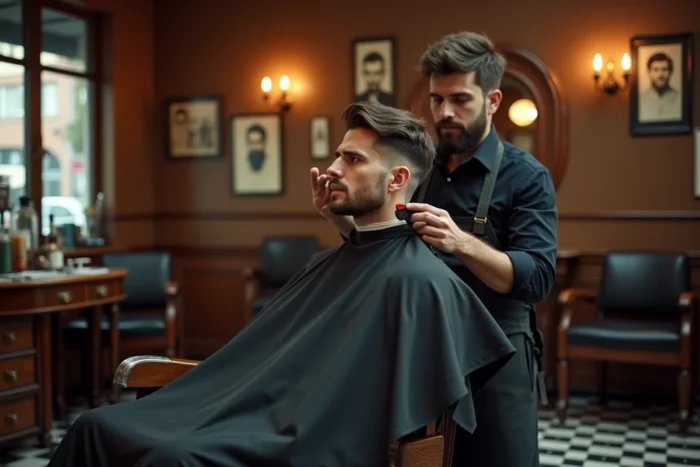
The connection between the beard and the lateral fade of the blended V creates a technical friction area at the level of the sideburns and jawline. The alignment between the beard line and the height of the fade determines the visual balance of the cut from the side.
A fade that goes too low with a short beard flattens the face. Conversely, a high fade combined with a long beard creates a gap between the ear and the jaw that the regrowth fills in an irregular manner.
Adjusting the height of the fade to the beard style
For a beard of a few millimeters, the fade can start low (above the ear) without imbalance. For a full beard, raising the starting line of the fade creates continuity between the density of the beard and that of the hair.
The connection itself is worked with an intermediate guard between the one used for the beard and the one for the hair fade. Jumping directly from one guard size to another creates a visible step at the temple, especially under side lighting.
The blended V fade remains a technical cut whose success relies less on the action than on the order of operations and the choice of tools by area. The tracing of the V is done with clippers, the fade is checked on dry hair, and thinning never crosses the demarcation line. Regular maintenance of the nape, adapted to the speed of regrowth, preserves the geometry between two complete cuts.