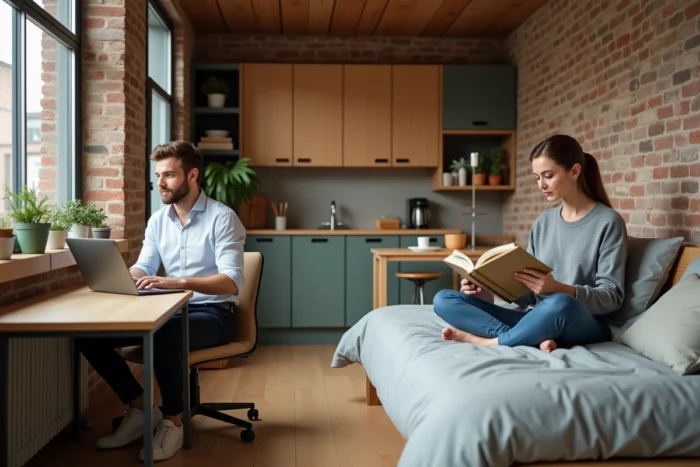
In France, the minimum legal area for a dwelling to be considered decent is set at 9 m² with a ceiling height of 2.20 m and a habitable volume of at least 20 m³. This threshold, designed for a single person, does not change when two occupants share the same space. Living together in a studio is therefore as much a couple’s choice as it is a reality constrained by law, the rental market, and the arrangement of daily life.
Minimum legal area and studio for two: what the decency decree says
The decency decree does not provide for a minimum area per occupant in private rentals. A landlord can legally rent a 9 m² studio to a couple without violating regulations, provided that the dwelling meets the volume and ceiling height criteria.
This absence of a threshold per person creates a legal blind spot. In practice, a studio of 14 or 16 m² rented to two occupants does not trigger any administrative alert, even if the living space per person falls well below what public health organizations recommend.
For those considering this configuration, it is useful to learn everything about Direct Immobilier before signing a lease, particularly regarding the area thresholds that make cohabitation truly feasible on a daily basis.
The health regulations of Paris add a local layer: the main room must reach 9 m² and 20 m³ of volume. However, these rules do not distinguish between one occupant and two. The law regulates the decency of housing, not the comfort of cohabitation.
EPC and rental ban: the supply of studios is shrinking
The regulatory timeline related to the energy performance diagnosis directly modifies the stock of available studios. Since 2025, properties classified G on the EPC are banned from rental. Properties classified F will be banned starting in 2028.
Older small units, often poorly insulated, account for a significant portion of energy-hungry labels. For a couple looking for an affordable studio in the city center, this restriction reduces the number of listings without causing rents for the remaining properties to drop.
The estimated depreciation for unrenovated energy-hungry properties reaches 15 to 25% on the price per m², prompting some owners to withdraw their property from the rental market rather than undertake renovations. The result: less choice, more competition among tenants, and renovated studios rented at prices sometimes exceeding what two modest incomes can bear.
Lease, rent, and income: the administrative realities of studio cohabitation
Legally, two people in a couple can be listed on the same lease. The situation varies depending on their status: cohabiting partners, civil partners, or married couples have different rights in the event of separation or if one of them leaves.
Solidarity clause and rental risk
Most leases include a solidarity clause. If one of the two leaves the dwelling, the other remains liable for the entire rent. For cohabiting partners who are not civilly partnered, this clause can extend for six months after the effective departure of the co-signer.
This point is rarely anticipated by couples moving in together for the first time. The solidarity clause financially commits beyond the duration of cohabitation.
Income requirements from agencies
Real estate agencies generally require net incomes representing at least three times the rent amount. For a studio with a rent around the average of a large city, the two incomes are often combined to meet this threshold. If one of the two is a student or job seeker, a guarantor becomes almost mandatory.
- Check if the lease explicitly mentions both occupants as co-tenants or if one is listed as a simple occupant
- Request the removal or limitation of the solidarity clause during lease negotiations
- Anticipate the separation scenario: who stays, who leaves, and under what financial conditions
Furnishing a studio for a couple: practical trade-offs
The layout of a shared studio is not just about buying compact furniture. Cohabitation in a single room requires making decisions on issues that living in a larger apartment allows one to avoid.
The first trade-off concerns sleeping arrangements. A convertible sofa frees up space during the day, but its bedding quality often remains poor over time. A real bed takes up space but protects sleep, which becomes a health issue when two people live, work, and sleep in the same room.
Visually separating rest and activity areas changes the perception of space. A thick curtain, an open bookshelf, or a sleeping platform is enough to create a symbolic boundary between the sleeping area and the rest of the studio.
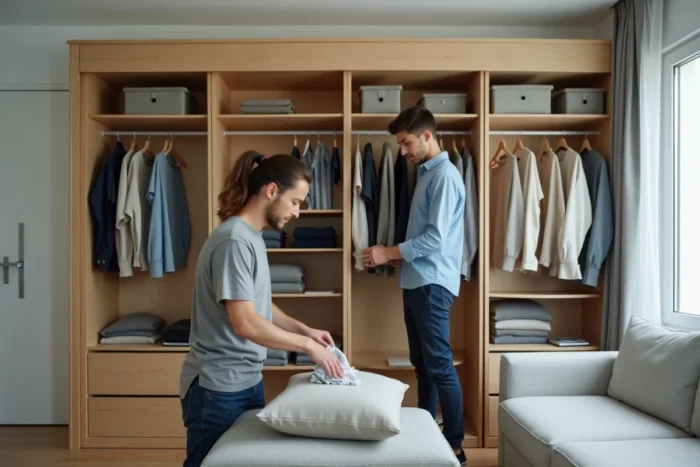
The second trade-off concerns storage. Two people in a studio means twice as many clothes, shoes, and personal belongings. Without vertical storage (high shelves, lofts, wall hooks), clutter sets in within weeks.
Seasonal rental of the studio in case of absence: legal limits
Some couples consider subletting their studio occasionally on seasonal rental platforms to offset the cost of rent. This strategy faces an increasingly strict regulatory framework.
In many French municipalities, the primary residence can only be rented out for 90 to 120 days per year, with mandatory declaration and registration number. Fines for non-compliance can reach 10,000 euros, or even 20,000 euros in case of false declaration.
For a studio occupied by two, subletting also requires the written agreement of the landlord, which is rarely obtained. A studio in traditional rental cannot become an Airbnb without real legal risks.
Living together in a studio remains a viable option as long as one accurately measures what the law allows, what the market offers, and what daily life demands. The floor area does not say it all: it is the clarity of agreements between roommates, the quality of the signed lease, and the awareness of one’s own spatial limits that determine whether the experience can last.