
Installing a shelf on drywall, assembling a solid wood piece of furniture, or marking a 45° angle on a baseboard: each situation requires a different square. The term “square” actually encompasses a family of tools with very diverse shapes, materials, and functions. Choosing the wrong model risks creating a wobbly assembly or an imprecise marking. Let’s take a look at the most useful types of squares for DIY and the criteria that guide the choice.
Multifunction Carpenter’s Square: The Tool That Replaces Three Accessories
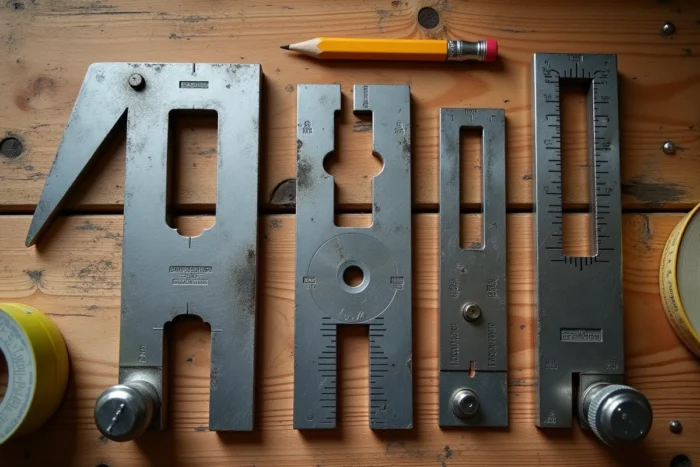
On a wooden terrace or pergola site, you often find yourself juggling between a protractor, a marking ruler, and a cutting guide. Recent metric aluminum carpenter’s squares integrate these three functions. They combine multiple graduations, marking notches, and a straight edge that serves as a guide for the circular saw.
You can check the position of the square on Normandie Libre to better understand how each angle configuration modifies the final marking. In practice, this multifunction model is suitable for DIYers working with outdoor wood (garden sheds, fences, cladding) who want to limit the number of tools in their bag.
One carpenter’s square replaces a protractor, ruler, and cutting template. The time savings are real when making multiple cuts on rafters or decking boards.

Fixing Brackets: Choosing the Right Material for the Wall Support
Fixing brackets are used to hold an assembly at a right angle, not for marking. They are screwed between two pieces of wood, between a shelf and a wall, or between a countertop and a kitchen cabinet. The choice of material directly depends on the support and the load.
- Galvanized Steel: Suitable for common fixings on solid wood, resistant to moderate humidity. This is the standard for garage or laundry room shelves.
- Stainless Steel: Preferable in humid environments (bathroom, kitchen, outdoors). More expensive, but does not rust when in contact with water or steam.
- Reinforced Square (ribbed): Designed for heavy loads. It is recognized by its central ribs that increase rigidity. It is suitable for kitchen countertops and heavily loaded storage shelves.
- Plastic Square: Lightweight and discreet, but the load capacity of plastic squares remains limited. User feedback indicates gradual deformation under heavy load, especially for library shelves.
On drywall, the type of anchor is as important as the square itself. A reinforced square fixed with an unsuitable anchor will not hold. Molly anchors or toggle bolts are used for hollow drywall, and expansion anchors for solid brick.
Marking Square and False Square: Two Tools, Two Logics
The marking square (or carpenter’s square) has a fixed 90° angle. It is used to check the perpendicularity of an assembly, mark straight lines on a board, or ensure that a frame is square before gluing. It is the basic tool for indoor woodworking.
The false square, on the other hand, has a pivoting blade that can be locked at any angle. The false square allows you to reproduce an existing angle on a piece to be cut. Typically, you measure the angle of a wall that is not 90° (which often happens in older homes), and then transfer that angle to the baseboard or kitchen countertop to be adjusted.
The confusion between these two tools leads to many errors. If you try to mark a non-right angle with a fixed square, you’ll end up with a baseboard joint that gaps. Conversely, using a false square to check a right angle is less reliable than a rigid square, because the play in the blade introduces a margin of inaccuracy.
Hat Square for Metal
Less known in home DIY, the hat square offers superior precision thanks to its machined heel that rests against the piece. It is primarily found in metalworking and fitting. For a DIYer who does occasional welding or milling, it is a worthwhile purchase. For woodworking or wall fixing, it does not offer anything more than a good marking square.
Magnetic Square for Welding: A Very Specific Use Case
The magnetic square holds two metal pieces in position during welding tacking. You place it, and it holds itself thanks to its magnets, freeing up both hands for welding. It comes in fixed angles (45°, 90°, 135°) or in an adjustable version.
The magnetic square frees both hands during welding tacking. This is its only real advantage, but it radically changes the comfort of work when welding alone. Feedback varies on this point: some DIYers find the magnetism insufficient on thick pieces, while others use it daily without issue.
For wood DIY or wall fixing, this tool has no utility. It is mentioned because it often appears in search results for squares, but its use is strictly limited to welded metal work.
Criteria for Choosing a Square Suitable for Your Project
Rather than building a collection, it is better to target two or three models based on your actual projects.
- Indoor wood DIY (shelves, furniture, frames): a rigid carpenter’s square and a false square cover the majority of marking needs. Galvanized steel fixing squares complement for assembly.
- Kitchen layout and wall fixing: ribbed reinforced squares, combined with anchors suitable for the support (drywall, brick, concrete), ensure the stability of the countertop or upper cabinets.
- Outdoor wood work (terrace, pergola, shed): the multifunction carpenter’s square in aluminum simplifies marking and cutting guidance on site.
The material of the wall support determines both the strength of the fixing and the square itself. Matching the anchor to the support is as crucial as the choice of the square. A reinforced square on poorly anchored drywall will not solve anything.
Lastly, often overlooked: the size of the square. For marking on large pieces (plywood panels, countertops), a square of at least 30 cm avoids alignment errors. For small woodworking assemblies, a 15 cm model is sufficient and easier to handle in tight spaces.