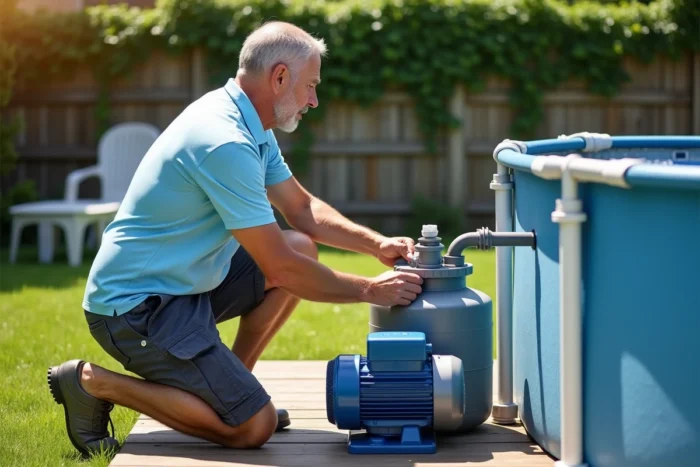
An Intex sand pump operates on a simple principle: water from the pool passes through a tank filled with filtering media (sand or glass) that retains impurities, then returns clarified to the pool. The quality of the installation directly affects the efficiency of this filtration. A loose connection or a poorly positioned pump can lead to a loss of flow rate, sealing, or sometimes both.
Electrical connection of the Intex pump: the NF C 15-100 standard
Before touching the pipes, the first point to address is the electrical supply. Intex manuals mention the power and the protection rating (IPX4 or IPX5 depending on the model), but remain discreet about the French regulatory framework.
The NF C 15-100 standard requires a dedicated 30 mA differential circuit breaker for any electrical equipment located near a pool. The sand pump must be connected to this protected circuit, not to an extension cord shared with the barbecue or garden lighting.
The distance between the pump and the pool depends on the equipment’s IP rating. For a model rated IPX4, a greater distance must be maintained than for an IPX5. The safety volumes defined by the standard delineate areas where certain electrical equipment is prohibited or subject to enhanced protections. Checking the IP rating on the model’s nameplate allows for proper positioning without improvisation.
To visualize the complete circuit and each connection between the pool, the valve, and the tank, a detailed Intex sand pump installation diagram facilitates understanding of the setup before moving on to practice.
Filling the tank: choice of filtering media and quantity
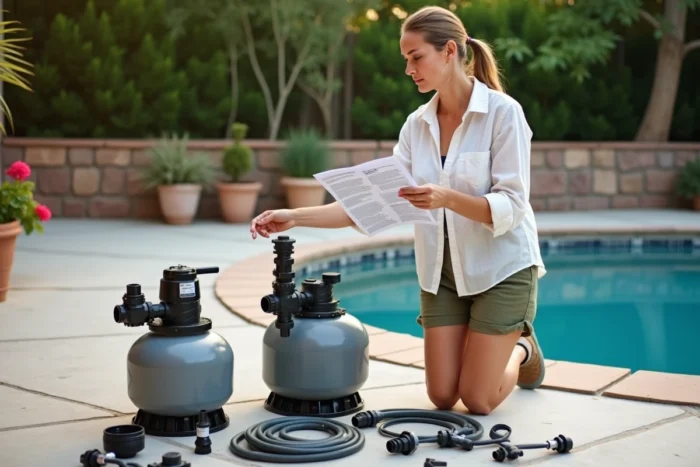
The Intex sand filter tank accepts two types of media: classic silica sand (granule size suitable for the model) and filter glass, which is finer in retaining impurities. Recycled glass retains smaller particles than sand, improving water clarity without altering the pump’s flow rate.
Regardless of the chosen media, the filling follows a fixed rule: never exceed two-thirds of the tank. Overfilling compresses the filter bed and reduces filtration quality instead of increasing it.
Protecting the diffuser during filling
The diffuser (or strainer) located at the bottom of the tank is fragile. Before pouring in the sand or glass, blocking the opening of the central tube with a cloth or temporary plug prevents grains from entering the return circuit. Once the media is in place, remove the plug, reassemble the multiport valve, and tighten the clamp.
Connecting the pipes and Intex multiport valve
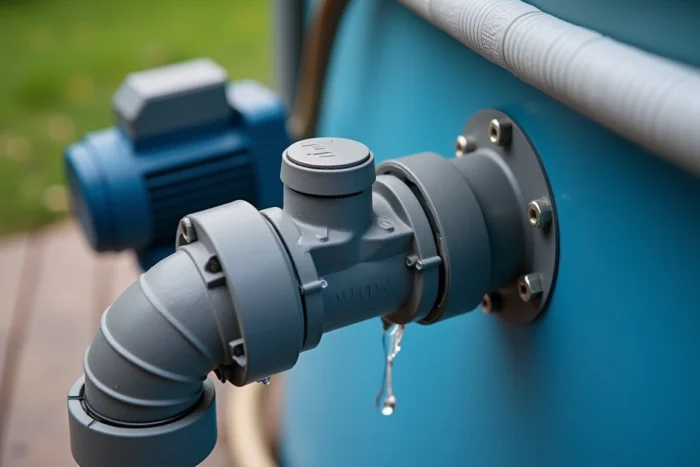
The hydraulic circuit of an Intex sand filter relies on two flows: suction (from the pool to the pump) and discharge (from the tank to the pool). Each pipe connects to the fittings provided with clamps. An insufficiently tightened connection causes air intake, recognizable by bubbles in the discharge jet.
The multiport valve (or 6-way valve on common models) directs the water flow according to the desired function:
- “Filtration” position for daily operation: water flows through the sand from top to bottom and returns filtered to the pool
- “Backwash” position to clean the media: the flow reverses, and impurities trapped in the sand are discharged to the drain
- “Rinse” position after each backwash: it stabilizes the sand bed before returning to filtration, preventing cloudy water from being sent back to the pool
Never turn the valve while the pump is running. Changing the position under pressure damages the internal star seal, a part whose replacement requires completely disassembling the valve.
Priming the Intex sand filter: the sequence to follow
Priming involves filling the circuit with water before starting the pump. Without this step, the pump runs dry and the internal mechanical seal overheats within minutes.
Priming steps
First, fill the pool to the level of the skimmer or suction inlet. Then open the pump’s pre-filter (the transparent cover at the front) and fill it with water manually. Close the cover, ensuring the O-ring is properly in place, and then set the valve to “Filtration”.
Upon starting, air bubbles exit through the discharge nozzle into the pool. Priming is complete when the flow becomes continuous and bubble-free, which usually takes a few minutes. If bubbles persist, turn off the pump, check the clamps and the pre-filter seal, then restart.
Maintenance of the sand filter: washing frequency and warning signs
An Intex sand filter equipped with a pressure gauge makes monitoring simple. The reference pressure is read just after a wash cycle when the media is clean. When the pressure gauge shows a value significantly higher than this reference, the sand is clogged and a wash cycle (backwash) is necessary.
During regular pool use, washing every one to two weeks is sufficient for most above-ground pools. Factors such as surrounding vegetation, the number of swimmers, or the absence of a cover accelerate clogging.
- Check the pressure gauge before each swim to spot any abnormal pressure rise
- After each backwash, always go through the “Rinse” position for a few dozen seconds
- Replace the sand (or glass) every three to five years depending on usage, as the media gradually loses its retention capacity
The cleaning of the pump’s pre-filter completes the maintenance. This basket collects the largest debris (leaves, insects) before they reach the tank. Emptying it weekly protects the filtering media and maintains the pump’s nominal flow rate.
A properly installed and maintained sand filter keeps water clear throughout the season. The most often overlooked point remains the electrical connection to standards and the positioning of the pump, two elements that condition both the safety and longevity of the equipment.