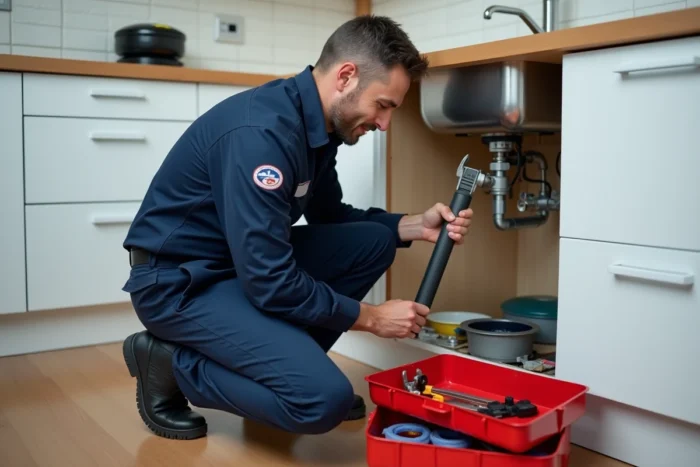
In France, the plumbing sector remains one of the most sought-after for home interventions. Leaks, outdated pipes, water heater replacement: these tasks affect both older homes and new constructions. Hiring a professional plumber for these interventions raises questions of compliance, insurance coverage, and the durability of installations that go far beyond mere technical gestures.
Home Insurance and Plumbing: What a Non-Professional Intervention Covers (or Does Not Cover)
A rarely discussed aspect in consumer guides concerns the direct link between the qualifications of the technician and the insurer’s coverage of a claim. In the event of water damage, the insurance company examines the origin of the problem. If the installation was carried out or modified by an unqualified individual, the insurance may refuse to cover the claim.
This situation is not marginal. Home multi-risk contracts frequently include clauses requiring that installations comply with current standards. A registered and insured plumber provides two additional protections: their professional liability insurance covers any damages during the intervention, and their ten-year guarantee protects the owner against structural defects for ten years after the work.
The advantages of a professional plumber are therefore also measured by the financial risk avoided in the event of a claim, a parameter that the cost of a DIY intervention never takes into account.

Compliance of Plumbing Installations: Standards and Owner Responsibility
Sanitary and water distribution installations in a home must comply with specific regulatory frameworks. These standards pertain to the materials used, pipe diameters, backflow prevention devices, the separation of drinking water and wastewater networks, and connections to the public network.
A trained plumber (holding a CAP in Sanitary Installation or an equivalent title) masters these technical requirements. This training is not trivial: it determines the legal compliance of the installation.
Responsibility in Case of Non-Compliance
The owner of a property is legally responsible for the compliance of their installations. In the case of resale, a defect in the plumbing network can be classified as a hidden defect. In the case of rental, the landlord must provide decent housing with installations in good working order.
Hiring a qualified professional produces a documentary trace (quote, invoice, insurance certificate) that serves as proof in case of a dispute. A DIY job does not benefit from any of these protections.
Plumbing Work and Energy Renovation Aids: The Unknown Link
Some plumbing work qualifies for financial aid, provided that the company carrying it out is qualified. Replacing an energy-hungry water heater with a high-performance model, installing water-saving equipment, or optimizing hydraulic heating networks fall within the scope of several renovation aid programs.
- Using a qualified craftsman (often labeled RGE for energy-related work) is a condition for eligibility for public grants and subsidies.
- A professional plumber can verify the project’s eligibility for different programs before the work begins, avoiding unpleasant surprises later.
- Without the intervention of a qualified professional, financial aid is inaccessible, even if the work done is technically identical.
This point transforms the economic calculation: the apparent extra cost of a professional compared to a DIY intervention can be offset, or even canceled, by the aid obtained.

Diagnosis and Durability: What a Professional Plumber Detects Upfront
The added value of a plumber goes beyond the act of repair. Field experience allows for the identification of latent problems that the average person may not see. A visible leak under a sink may indicate advanced corrosion of the upstream network. Insufficient flow may reveal widespread limescale buildup in the pipes.
Preventive diagnosis avoids more costly emergency interventions. An experienced professional spots signs of wear on seals, fittings, and pipes, and proposes a maintenance plan tailored to the age and configuration of the installation.
Materials and Technical Compatibility
The choice of replacement materials (copper, PEX, multilayer) depends on the existing network, water pressure, and intended use. A poor match between a new pipe and an old network can cause galvanic corrosion or leaks at the joints.
A qualified plumber selects compatible materials and correctly sizes the installations. This technical expertise reduces the risk of premature failure and extends the overall lifespan of the network.
Real Cost of a Professional Plumbing Intervention: Beyond the Hourly Rate
The price of a professional plumber is often compared, incorrectly, to the sole cost of parts purchased at a DIY store. This comparison overlooks several factors:
- Specialized tools (bender, inspection camera, test pump) represent an investment that the average person does not recoup on a single intervention.
- The time spent by a non-professional is generally two to three times greater than that of a trained craftsman, with no guarantee of results.
- A poorly executed repair generates corrective interventions whose cumulative cost exceeds that of the initial intervention by a professional.
The overall cost of amateur work often exceeds that of a professional when factoring in the risk of a claim, the absence of guarantees, and the time invested. Field feedback varies on this point depending on the complexity of the work, but for any intervention involving pressurized water networks or drainage, the risk-benefit ratio clearly favors the professional.
Hiring a qualified plumber for plumbing work at home is less about comfort and more about rational risk management. Between insurance coverage, regulatory compliance, access to financial aid, and the durability of installations, each aspect advocates for an intervention framed by a professional in the sector.