
A medical biology prescription does not function like a medication prescription. The confusion between these two regimes leads to refusals in the laboratory and avoidable out-of-pocket expenses. Clarifying the rules for reusing a blood test prescription requires distinguishing three parameters: the legal validity of the document, the reimbursement conditions by Health Insurance, and the derogatory framework applicable to chronic diseases.
No legal duration for a medical biology prescription
Unlike medication prescriptions, which are subject to a three-month presentation period at the pharmacy, no text sets a legal validity duration for a blood test prescription. The Public Health Code remains silent on this specific point. The medical analysis laboratory therefore has discretion to accept or refuse an old prescription.
In practice, the commonly applied limit is twenty-seven months after the prescription date. This threshold does not stem from a regulatory obligation but from a technical constraint related to billing and reimbursement via the Vitale card. Beyond this period, the laboratory may refuse to honor the prescription or charge the patient directly without going through third-party payment.
We recommend not to confuse “validity of the document” with “medical relevance.” A prescription for a complete blood test that is over a year old may be legally usable, but the prescribed tests may no longer correspond to the patient’s clinical situation. A doctor may have modified the follow-up protocol in the meantime.
Reuse of the same prescription: reimbursement and practical limits
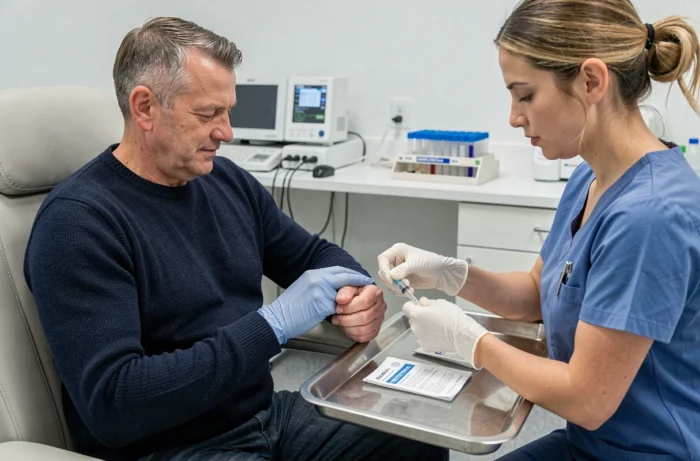
The question of reuse mainly arises for monitoring tests prescribed at regular intervals. A doctor who prescribes a blood sugar check every three months can write a single prescription covering multiple samples over a given period. The laboratory will then agree to perform each blood draw upon presentation of the same document, provided that the frequency and type of tests remain consistent with the initial prescription.
Reimbursement by Social Security remains possible as long as the prescription is less than twenty-seven months old. After this threshold, coverage is no longer guaranteed, even if the laboratory agrees to perform the sample. The complementary mutual insurance generally follows the same logic: without reimbursement from the mandatory scheme, the contract does not take over.
Three situations justify reuse:
- The doctor has explicitly mentioned a periodicity on the prescription (for example, “to be renewed every 3 months for 1 year”), which allows multiple visits to the laboratory on a single document.
- The follow-up of a chronic condition requires regular biological checks with a stable and predictable rhythm.
- The patient is unable to obtain a new medical appointment within the usual timeframes, and the laboratory deems the prescription still relevant.
On the other hand, a one-time prescription without a renewal mention can only be used once. A test prescribed as part of an initial diagnosis or an annual check-up is by nature non-reusable: the laboratory will refuse a second sample on the same prescription.
Chronic diseases and continuity of care: the derogatory framework
Patients with long-term illnesses or those being followed for a chronic condition benefit from a distinct regime. A guide for liberal nurses, recently updated, specifies that a blood sample for monitoring can be taken even when the initial prescription is technically expired. The condition: stay within the exact scope of the original prescription (type of acts, rhythm, clinical context) and promptly alert the prescribing physician for a renewal.
This mechanism aims for continuity of care, not unlimited reuse. The healthcare professional performing the sample assumes responsibility. If the clinical context has changed or if new tests have been prescribed in the meantime, the derogation no longer applies.
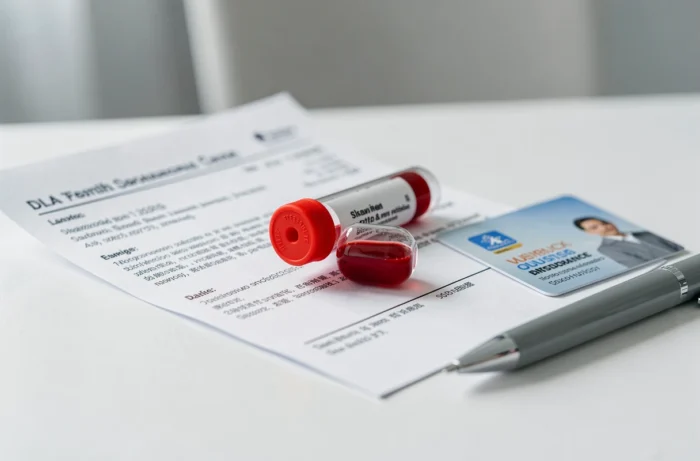
We observe that this flexibility is poorly known to patients and sometimes even to the laboratories themselves. A diabetic patient whose follow-up prescription expires between two consultations can legitimately have their HbA1c check performed, provided that their doctor is informed within a reasonable timeframe.
Expired or lost prescription: what to do at the laboratory
A laboratory faced with an old prescription generally applies an internal decision grid. The medical biologist checks the consistency between the requested tests and the patient’s context, then assesses the risk of non-reimbursement.
Without a valid prescription, the laboratory can perform the tests but without coverage by Health Insurance. The patient then pays the full costs. Most common tests (CBC, blood sugar, lipid profile, liver function tests) remain accessible without a prescription, but on a paid basis.
To avoid this situation, two concrete options:
- Ask the treating physician for a prescription explicitly mentioning the periodicity and desired validity duration for recurring tests.
- Anticipate the renewal by making an appointment before the current prescription expires, especially in areas where consultation delays exceed several weeks.
- Keep a digital copy of the prescription: some laboratories accept a readable scan or photograph, which limits the risk of losing the paper document.
The development of e-prescription, planned by the ordinance of November 18, 2020, should ultimately simplify the management of renewals by making prescriptions accessible from a digital space shared between the doctor, the patient, and the laboratory. However, the actual deployment date remains to be confirmed.
The reuse of a blood test prescription therefore depends less on a fixed timeframe than on the nature of the prescription. Chronic follow-up with mentioned periodicity offers real leeway. A one-time test, however, remains a unique act. Checking the renewal mention on the document before presenting it to the laboratory remains the most reliable reflex to avoid a refusal or unexpected out-of-pocket expenses.