
Jean-Pierre Papin, born on November 5, 1963, in Boulogne-sur-Mer, is the only French footballer to have won the Ballon d’Or while playing in Ligue 1. His journey is not limited to spectacular goals: after his career as a player and then as a coach, he has built a structured transition around sports consulting and club management.
Papin’s Role as Advisor at Olympique de Marseille
Since the end of 2022, Jean-Pierre Papin has held the position of advisor to president Pablo Longoria at OM. This role goes far beyond the status of ambassador or nostalgic figure that clubs reserve for their former glories.
His regular presence at the training center gives him an interface role between management, the technical staff, and the locker room. Papin participates in the strategic steering of the sports project, with a direct influence on the club’s directions.
A rarely highlighted aspect: he links sports performance to economic viability. His statements emphasize the necessity for OM to control its costs and build a long-term project, far from the logic of unlimited spending associated with the Tapie era. For those interested in details about Jean-Pierre Papin’s fortune, this managerial stance sheds light on how he has managed to transform his sporting capital into sustainable professional capital.
Coaching and Assistant Career: The Lesser-Known Stages
Papin’s post-playing career as a coach remains under-documented compared to his playing career. However, he has accumulated varied experience in very different contexts.
- Head coach at RC Strasbourg and assistant at RC Lens, two Ligue 1 clubs with distinct structures and ambitions.
- Indirect involvement in African football, through his former assistant Sébastien Migné, who became the coach of Gabon, showcasing a network of influence that extends beyond French football.
- A pedagogical approach focused on training strikers, an area where his technical expertise is still recognized by the staff he has worked with.
This diversity of experiences (French club, technical staff, international network) constitutes a capital of expertise that few former Ballon d’Or winners can claim. Papin has built a second career based on transmission rather than mere fame.
Ballon d’Or 1991 and the French National Team: What the Statistics Don’t Say
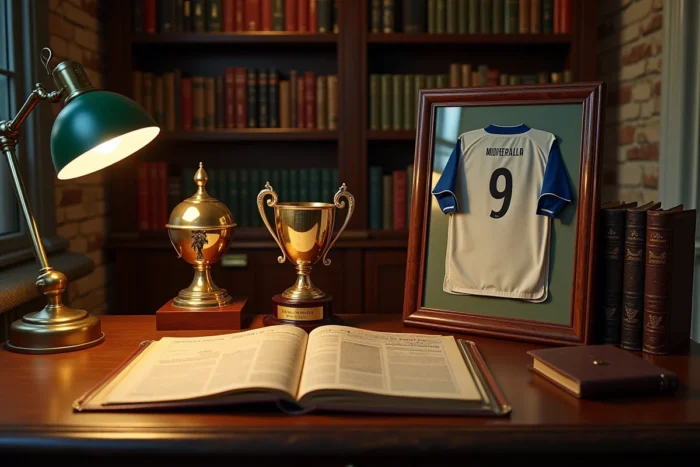
In 1991, Papin won the Ballon d’Or after several seasons as the top scorer in the French championship with Marseille. The trophy rewards a striker whose style, characterized by half-volley strikes and instinctive movements, redefined the number 9 position in French football.
With the French national team, his record stands at 30 goals in 54 appearances. This ratio places Papin among the most efficient strikers in the history of Les Bleus. He ensured the transition between the aging Platini generation and the still nascent Zidane generation.
The context of the time deserves to be recalled: France did not qualify for the 1990 World Cup or the 1994 World Cup. Papin carried a struggling selection, notably competing in the qualifiers in a climate of national doubt. His offensive contribution maintained the competitiveness of Les Bleus during a lean period.
The “papinnade” as a Technical Signature
The gesture that bears his name, the pivot volley, remains associated with a rare ability: striking the ball while suspended, often with his back to goal, with a precision that stemmed as much from reflex as from repeated practice. This technical gesture gave rise to the term “papinnade,” which has entered the vocabulary of French football.
Jean-Pierre Papin’s Wealth and Transition: An Atypical Model
Papin’s financial trajectory after football stands out from many former players of his generation. While some have faced difficulties after their careers, Papin has diversified his activities.
His transfer from Marseille to AC Milan in 1992, followed by stints at Bayern Munich and Bordeaux, ensured him significant income during his active career. The continuation relies on several pillars:
- The role of media consultant, with regular appearances in French sports media.
- The roles of coach and assistant, generating income but also an extensive professional network.
- The position of advisor at OM, which combines remuneration and strategic influence within a leading Ligue 1 club.
Papin’s transition is based on expertise rather than image. His current roles at Marseille show that he has managed to convert his knowledge of high-level football into operational competence, a transition that few former players achieve.
Valenciennes, Bruges, Marseille: The Construction of a European Striker
Before the Ballon d’Or and multi-million transfers, Papin built his career step by step. His beginnings at Valenciennes in the second division, followed by his time at FC Bruges where he won the Belgian Cup, outline a progressive journey.
The choice to go to Belgium at a time when French players rarely expatriated reflects a calculated risk. In Bruges, he scored 33 goals in 44 matches, statistics that caught the attention of Olympique de Marseille.
His arrival at OM in 1986 marks the beginning of a period where Papin became the top scorer in the French championship for five consecutive seasons. This consistency, combined with campaigns in the Champions League with Marseille, established him as one of the major strikers in European football in the late 1980s and early 1990s.
Jean-Pierre Papin’s career illustrates a pattern that has become rare: a player trained in lower divisions, passing through a modest foreign league, who reaches the pinnacle of world football before transitioning into sports management roles. His current position at OM closes a loop that began four decades ago, with a coherence that the erratic paths of many former champions do not always allow.