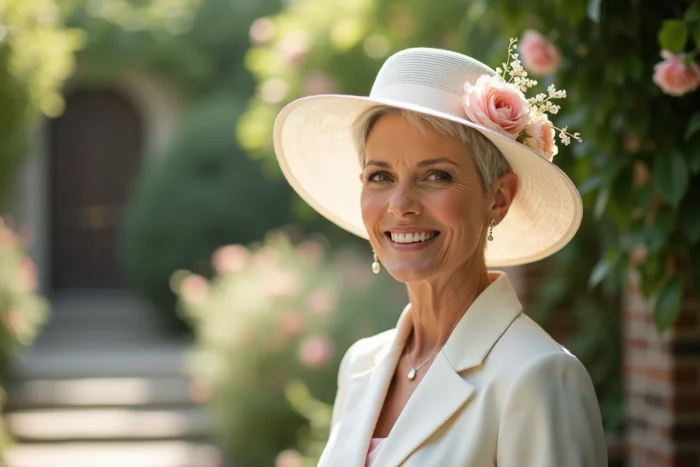
A well-defined pixie, a boater hat tilted to the side, an outdoor ceremony: the hat slips, tilts, and ends up in the grass before dessert. On short, mature hair, the problem is almost never aesthetic. It’s a matter of support, texture, and proportions between the headwear and the actual volume of the hair.
Texture of Mature Hair and Hat Stability: The Real Starting Point
After 50, hair fibers thin and lose density. We lose that cushion effect that naturally holds a hat on the head. The result: a model that fit perfectly at 35 floats or tilts ten years later, especially with a short cut where there is no mass to compensate.
The solution lies in preparing the hair before placing anything on it. A lightweight volumizing mousse applied to damp hair creates lift without stiffness. A dry texturizing spray, misted at the roots once styling is complete, provides enough grip for the hat to stay in place.
If choosing a wedding hat for women with short hair, it’s beneficial to style the hair according to the specific model, not the other way around. A short veil fascinator requires volume on top, while a wide-brimmed hat works better with a sleek cut on the sides and movement at the nape.
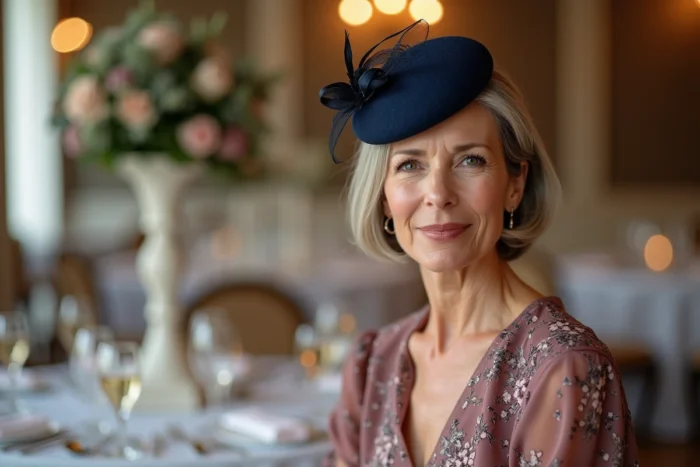
Wide-brimmed Hat, Fascinator, or Boater: Which Wedding Hat for Your Face Shape
It’s said everywhere that you should choose your hat based on your face shape. This is true, but with short hair, the cut itself alters the perceived proportions. A short bob with volume on the sides visually widens an elongated face. A pixie cut above the ears accentuates the jawline.
Round or Full Face
Avoid cloches and flat-placed fascinators that flatten features. An asymmetrical brim hat or a tilted wide-brimmed hat creates a diagonal that elongates the face. On a textured pixie, the tilt works particularly well because the nape’s exposure emphasizes verticality.
Long or Angular Face
The flat-brimmed boater cuts the height of the forehead. With a short layered cut, you can let a few strands peek out from under the brim to soften the angles. A voluminous fascinator, placed slightly back, also works: it visually shortens the top of the face without crushing the hairstyle.
Oval Face
Most shapes work well. Focus then on the style of the ceremony. A rustic wedding can accommodate a fine straw boater. An urban ceremony calls for a structured fascinator or a short feather fascinator.
Securing the Hat on Short Hair After 50: Practical Techniques
This is the part that most guides skim over, yet it’s the one that can ruin the day if neglected. With long hair, you can pin it, and the hat stays put. With a pixie cut or very short bob, you need to be clever.
- Combs integrated into the hat (often found on fascinators and hats) work better when you slightly backcomb the area where the comb will anchor. Two backcombing strokes at the roots are enough to provide grip.
- Long hat pins (8 to 12 cm) go through the headwear and slide under a strand at the base. They hold even on a pixie if oriented in a cross.
- A thin elastic headband, sewn inside the hat by a tailor, hugs the head and prevents slipping. This is the most reliable method for a wide-brimmed hat worn all day, from the reception to the dance.
- Matte wax applied to the sides creates a slightly sticky surface that holds the brim of the hat without marking the hair.
Feedback varies on the effectiveness of fixing sprays alone: some hairdressers find them sufficient on a short bob, while others deem them too light for an unbalanced fascinator. It’s recommended to combine spray and mechanical fixation to not have to think about it all day.
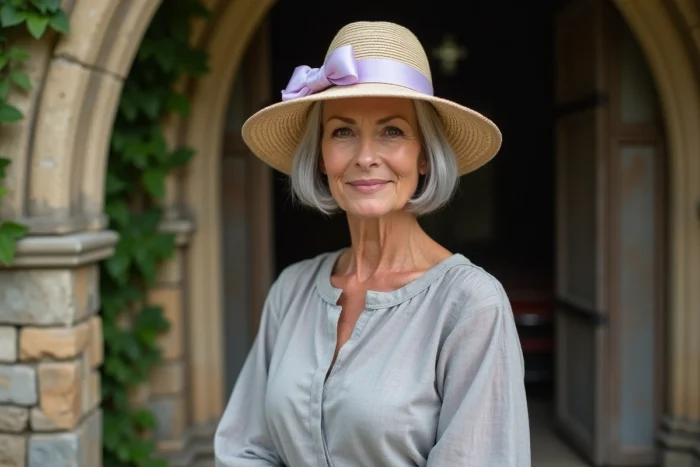
Protecting the Scalp and Hairstyle at an Outdoor Wedding
A summer wedding with a hat provides natural sun protection. But it’s often forgotten that the mature scalp is more vulnerable to UV rays, especially in areas less covered by a short cut (parting, temples, high nape).
A thermo-protective treatment applied before styling limits damage from the heat of styling tools or hair dryers. For exposed areas not covered by the hat, a hair sunscreen spray with UV filter prevents burns on the part and preserves color, whether natural or dyed.
Another often overlooked detail: removing the hat for photos shouldn’t ruin the hairstyle. If you’ve worked volume with a lightweight mousse and fixed with a texturizing spray, the hair returns to its shape in seconds. Running fingers through the roots is enough to restore movement, without a mirror or complete touch-up.
Complementary Accessories for Short Hair and Ceremony Hats
The hat doesn’t work alone. With a short cut, the ear is exposed, as is the nape. Dangling earrings or medium hoops add movement in the area that the hat leaves free.
A short veil attached to the fascinator gives a ceremonial look without overloading. On a pixie cut, it frames the eyes and slightly masks the forehead if desired.
However, avoid accumulation: hat, headband, clips, and statement necklace in the same look. With short hair, one strong accessory is enough. The hat plays this role. The rest accompanies without competing.
One last practical point: trying on the hat with the complete outfit, earrings, and makeup at least a week before the ceremony allows you to spot any issues, whether it’s a brim rubbing against glasses or a color clashing with lipstick. The day of the event is not the time to discover that the boater presses against the arms of your sunglasses.