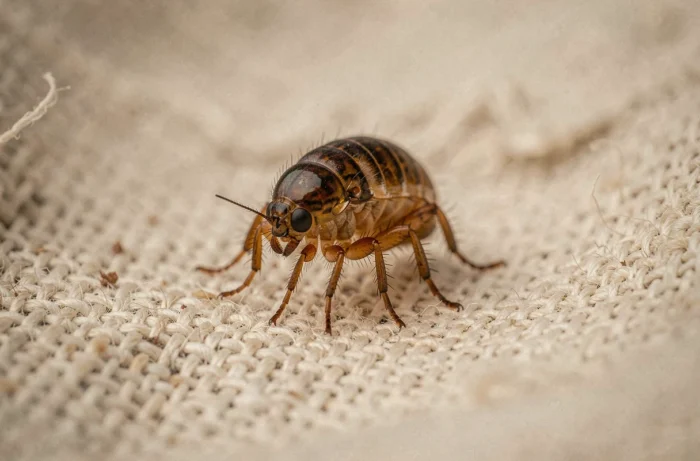
The flea is one of the insects most anciently associated with humans. Present in homes for millennia, it has traversed the centuries, leaving traces in language, literature, and popular beliefs. Its spiritual symbolism, less documented than that of the ladybug or butterfly, is based on cross-readings between animist traditions, psychoanalytic interpretations, and contemporary currents of personal development.
The flea in cultural history: an insect between disgust and fascination
Before any spiritual reading, the flea occupies a unique place in the European collective memory. The expression “to have a flea in one’s ear,” attested as early as the 13th century, initially referred to romantic anxiety before shifting towards the idea of a persistent suspicion. This linguistic detail reveals how much the animal has served as a metaphor for diffuse psychological states that are difficult to name.
In the literature of the Ancien Régime, the flea served as an erotic pretext. It appeared on women’s skin in gallant poems, playing the role of a miniature and indiscreet lover. An anonymous play published in 1520, The Trial of Women and Fleas, featured a fictional court where fleas took the stand to defend themselves. This interplay between repulsion and intimacy establishes a dual symbolism that persists today.
Those who wish to explore the spiritual meaning of fleas often find this tension between a bothersome parasite and a messenger carrying meaning, depending on the interpretative framework adopted.

Spiritual symbolism of the flea: intuitive alert and personal boundaries
In contemporary spiritual currents, the flea is interpreted as a warning signal related to intuition. Its recurring presence, in dreams or daily life, would signify that a toxic situation or an exhausting environment is tolerated out of habit. The insect would point to a need to readjust personal boundaries.
This reading is based on a simple analogy: the flea feeds on the blood of its host without the host immediately noticing. The parallel with draining interpersonal relationships or exhausting professional contexts is common in personal development literature. The flea would then symbolize a silent loss of energy that needs to be identified.
Survival and adaptability as a lesson
A less common angle is to see the flea not as a negative warning but as a figure of adaptability. The insect survives in hostile environments, changes hosts, and withstands extreme conditions. Ranked alongside cockroaches or ants in symbolic terms, the flea would represent the ability to navigate challenges with agility.
This positive reinterpretation transforms the parasite into a teacher of psychological survival. It invites recognition of one’s own resilience in the face of difficult periods, rather than focusing on the nuisance.
Fleas and other insects: a rarely established symbolic comparison
The spiritual meaning attributed to insects varies significantly by species. Comparing the flea with other common arthropods helps to better understand what distinguishes it.
- The ladybug has become an almost universally accepted symbol of luck, protection, and mercy in Francophone spiritual discourse. Its presence is perceived as benevolent, without ambiguity.
- The wasp is increasingly described as an energetic guardian, a messenger of purification and inner transformation, far from the purely aggressive image traditionally associated with it.
- The fly functions as an indicator of stagnant or impure energies, but some contemporary traditions also see it as a symbol of perseverance and transformation.
The flea occupies a different register. Where the ladybug reassures and the wasp shakes, the flea acts quietly. Its symbolism revolves around discretion, infiltration, and gradual awareness. It does not strike; it gnaws.

Dreaming of fleas: what psychoanalysis and popular traditions say
The dream dictionary classifies fleas among symbols of minor but persistent irritation. Dreaming of fleas would refer to everyday troubles that, taken in isolation, seem trivial, but whose accumulation produces a diffuse discomfort.
In some spiritual interpretative frameworks, dreaming of fleas on the body would signal an urgent need to purify one’s intimate space, whether it be the living environment or close surroundings. The fact that the flea is associated with the bed and night reinforces this interpretation: the insect appears in moments of vulnerability when conscious defenses are lowered.
The limits of these interpretations
The available data do not allow for a conclusion of a unified spiritual tradition around the flea. Unlike the scarab in ancient Egypt or the butterfly in Buddhism, the flea does not have a stable mythological corpus. Current interpretations draw from heterogeneous sources, and field feedback varies on this point according to the practitioners consulted.
This lack of a common foundation does not disqualify the approach, but it invites caution. The symbolism of the flea functions more as a personal mirror than as a codified system of signs.
The growing interest in the spiritual meaning of animals, including the most modest, reflects a need to connect nature to inner life. The flea, through its smallness and persistence, offers an unexpected support for reflection: what disturbs the most is sometimes what deserves the most attention.