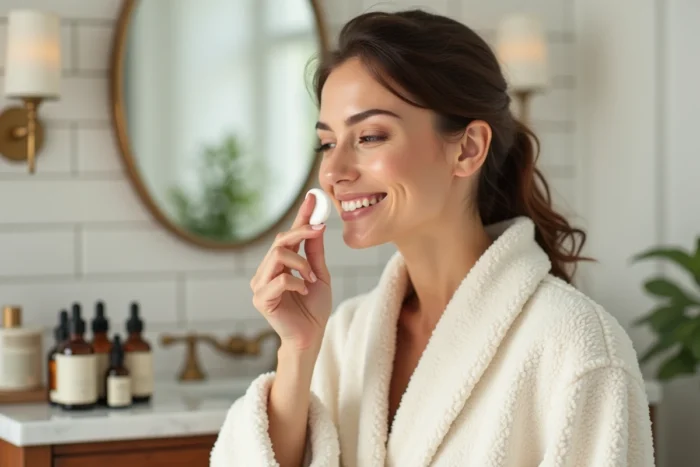
Your skin feels tight in winter, shines in summer, and reacts to the slightest change in cream. These variations are not a whim: they reflect how climate, ingredients, and your skin sensitivity interact on a daily basis. Enhancing your skin is less about accumulating products and more about making choices tailored to this trio of factors.
Seasonal beauty routine: adjusting your care to the climate without multiplying steps
Have you ever noticed that your winter cream becomes too rich as soon as spring arrives? This mismatch between the texture of a product and the actual needs of the skin explains many seasonal imperfections.
In cold periods, the skin barrier loses lipids. A vegetable oil or a rich balm compensates for this loss. In hot periods, the trend is the opposite: a lightweight serum advantageously replaces a thick cream. The trap would be to keep both at the same time out of habit.
Short and targeted routines are gaining ground. Rather than seven steps morning and night, several recent approaches favor three well-chosen gestures, adapted to the season. This also allows you to discover secretdebeaute.net in detail to find the care that corresponds to each time of the year.
The principle is simple: in summer, lighten the textures and enhance sun protection. In winter, focus on deep hydration and oily substances. In between, observe your skin before deciding.
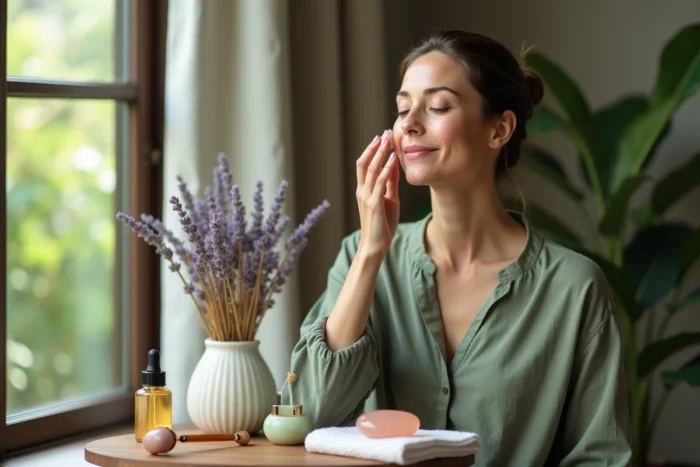
Skin sensitivity and ingredient choices: reading beyond the word “natural”
The term “natural” on a package does not guarantee the tolerance of a product. An organic essential oil can cause a reaction on sensitive skin, while a well-formulated synthetic active ingredient may pass without issue.
The skin type dictates the choice of ingredients, not the marketing label. Reactive skin needs short formulas with few components. Oily skin tolerates aqueous textures and gentle exfoliating acids better.
Three criteria to evaluate a product before purchase
- The INCI list (composition): the first ingredients represent the majority of the product. If the touted active ingredient appears at the end of the list, its concentration remains marginal.
- The total number of ingredients: a formula with fifteen components presents less risk of irritation than a formula with forty, especially for sensitive skin.
- The presence of fragrances or denatured alcohol at the top of the list: these two elements are among the most common irritants, even in products labeled “organic”.
Customization through skin diagnostics, sometimes assisted by artificial intelligence, is starting to offer recommendations tailored to each person’s profile. This approach contrasts with the logic of the long-dominant “universal routine” in beauty advice.
Cosmetic regulation and controversial substances: what is changing concretely
The promises of “paraben-free” or “silicone-free” have long been enough to reassure. The situation is evolving. The gradual ban on PFAS in cosmetics represents a concrete regulatory shift that directly affects the composition of many everyday products.
PFAS, these per- and polyfluoroalkyl substances used for their resistance and glide properties, are found in certain foundations, sunscreens, and long-lasting products. Their persistence in the environment and in the body has led several legislations to plan their removal.
For the consumer, this means two things. First, some formulations will change without the product name changing. Second, brands that anticipate these restrictions are already reformulating, which may alter the texture or performance of a familiar product.
How to check a product’s composition
Online databases allow you to scan or search for the INCI list of a product. Several mobile applications assign a risk rating to each ingredient. Their reliability varies, but they provide a useful first filter.
Favor brands that publish their complete lists on their site, without settling for a “clean beauty” logo whose definition remains vague.
Care formats and sustainable packaging: the trend of waterless cosmetics
Waterless care and solid or compressed formats are gaining visibility. The idea: to offer more concentrated, transportable formulas, often packaged in reduced or refillable containers.
A solid shampoo, for example, eliminates the plastic bottle and lasts as long as two regular bottles. Facial care in tablet form works on the same principle: water is added at the time of use.
- Solid formats (soaps, shampoos, makeup removers): less packaging, higher concentration of actives.
- Recycled or refillable glass packaging: reduction of single-use plastic, provided that the refill system is genuinely accessible.
- Tablets and powders to be reconstituted: compact format, extended shelf life due to the absence of water in the formula.
Differentiation now relies as much on packaging as on the formula. An effective product in a non-recyclable disposable container loses coherence with an audience increasingly attentive to environmental impact.

Adapting your beauty routine does not require changing everything with each season. Often, it is enough to remove a product that has become superfluous, adjust another to the current weather, and check that the composition truly corresponds to what your skin tolerates. Fewer products, better chosen, is the foundation of healthier skin.